


*Click on the photographs for an in-depth explanation of each painting


I have a window in my eye, if you look in you see the sky I
Title: I have a window in my eye, if you look in you see the sky I
Material: Earth and mineral pigment, chalk, color pencil, conte, shellac, blush and foundation on silk.
Size: 90cm x 65cm
Year: 2024
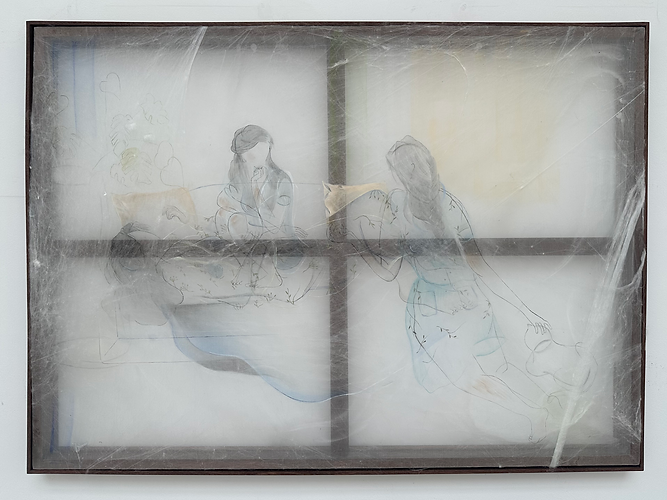
My practice shifted after the Easter break to focus on capturing fleeting moments of intimacy while articulating the temporality of the passage of time. In harmony with the ebb and flow of time, I also explore concepts related to disappearance and transformation within the fabric of intimate memories.It was also after the Easter holidays, I had a breakthrough in my understanding of materiality (which I will elaborate below).
Under 'methods, processes and materials', I explain why there was a shift in my research direction, as well as why I am interested in intimate moments.
This painting was the first piece I created after the Easter holidays. A summary of the process of creating this painting (will be further elaborated in other sections):
memory drawing (without prompt) -> memory drawing (with prompt)-> place silkworms on the canvas to spin silk
As with past works, I started this painting by delving into my memories. While post-Easter, I want to expand my practice beyond understanding the process of memory formation, memory drawing remains an essential aspect of my practice. As I recall details of particular moments, memory drawing becomes a pathway for me to suspend time and re-immerse myself in the intimate essence of those experiences (OpenAI Chat
GPT, 2024).It is more than just capturing the visual elements. The process creates a medium for me to reconnect with the intimate emotions accompanying those moments.Every brushstroke becomes a tactile endeavor into the contours of human connection and the delicate nuances of such intimate yet fleeting experiences.
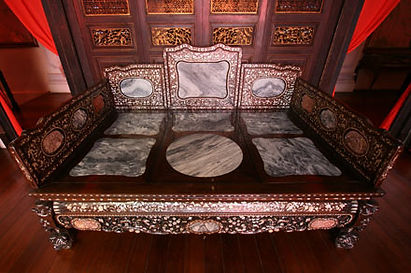
Traditional Peranakan day-bed. Often made out of pearl and wood (Thomas, 2011).

Photo taken from our gathering that day
We had a family and friends gathering the day I started on this painting. Hence, I had company when I was completing this painting. This was the first painting I created with people around me. Usually, when I am in London, I paint alone at home. It was a rather interesting experience as I was actively conversing with the people around me about this particular memory while completing the painting. In a way, it conformed to my usual technique of painting through memory drawing without any prompts, then adding layers through memory drawing with prompts.We were having such a good time I forgot to record the conversation. However, I got some individual recordings from guests that day. Some guests sent me DV tapes and photographs taken when my great-grandmother was still alive too.
The inspiration for this piece came about when I went back to Singapore for the easter break. I visited a friend and chanced upon a Pernakan daybed which was in her house. My great-grandmother used to have one in her house too.While not common in homes today, this piece of furniture once served as the centerpiece of social life in many Peranakan households.
I recall when my great-grandma and her sisters would gather around the Peranakan day bed as they exchanged gossip about their neighbors and shared family recipes passed down through generations.Nestled amongst the cushions, their voices would mingle with the scent of freshly brewed coffee and the rustle of traditional batik skirts.Those afternoons, the living room would be filled with the tantalizing aroma of traditional Peranakan dishes —freshly cooked bowls of laksa, rich rendang simmering on the stove, and delicate kueh lapis stacked high on plates (OpenAI ChatGPT, 2024). The scent of these dishes mingled with the laughter and conversation, creating a sensory tapestry that lingered long after the guests had gone.
That day, when I went home, I immediately got to work, layering on silk as I recalled various aspects of this memory.

Photo taken from our gathering that day: Made them pose nicely because I told then its going to be part of my studio diary . They complained I did not tell them to dress up beforehand, and insisted we take another photo after they had a change in outfit.
<<< The voice recording and DV tape supporting work is included below under the supporting work section>>
***Please click below to play the video***
Details:
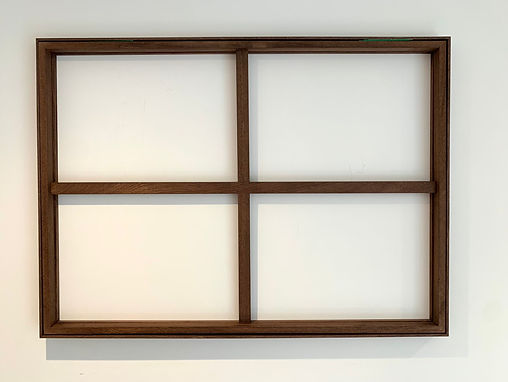
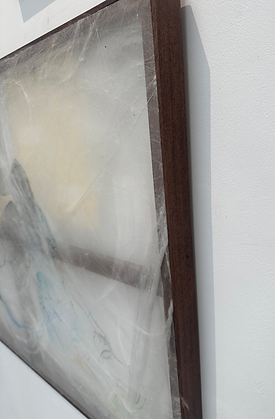
The tray frame I custom-made

Installing the cross-bars
I considered the sculptural aspect of art for this painting. The idea was to use the frames to create a 'window' effect.
After my previous painting, I realized that silk looks better with thin frames as it is a very delicate fabric. The ephemeral, ethereal quality of silk is also best demonstrated when not burdened by thick frames. However, thin stretchers are typically flat. To me, it is important that silk is able to cast shadows on the wall it is exhibited because it gives the compositions more depth. However, thin frames are typically flat. Additionally, I allowed live silkworms to spin silk directly onto the canvas for this painting. To secure the silk in place, I needed a tray frame, which was not available on the market, so I custom-made it.
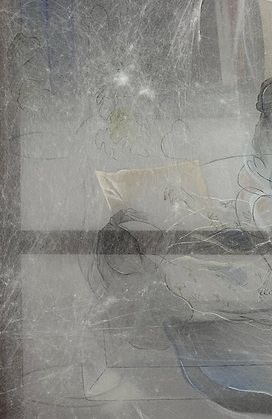
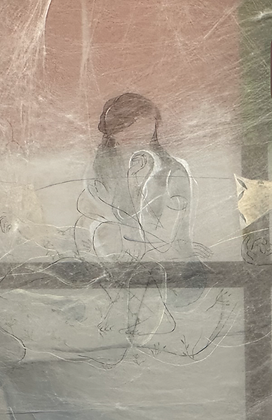
In this painting, I utilized overlapping lines. During a group critique with Gavin Edmond, we discussed abstract expressionism in the context of my classmate Alberto's works. A topic that was brought up was the power of line and gesture in conveying emotion. I do not typically paint abstract works. However, I found overlapping lines an intriguing concept that I could adapt to my practice. I realized that messing up the lines would make the canvas less restrained, which was aligned with the notion of intimacy, the ephemeral, and time.
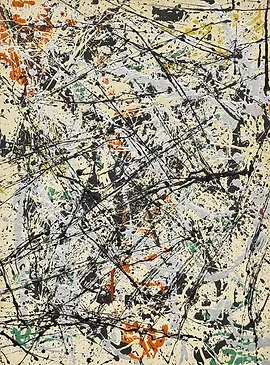
Much like the works of Jackson Pollock, whose drip paintings blur the boundaries between chaos and control, I hoped to use overlapping lines to add more depth to my composition whilst experimenting with a new style of expression while not throwing away my existing art style (MoMA, n.d.).
Jackson Pollock's Number 32, 1949 (MoMA, n.d.)
Moreover, the complexity and interconnectedness of human experiences and emotions are better depicted by overlapping lines than clean lines. Ironically, the following idea I had in mind was so complex and convoluted in my brain that I had to enlist the help of ChatGPT to put words to my thoughts. I wanted to convey the idea that:
"Layering lines upon lines mirrors the overlapping narratives that shape our identities. The overlapping lines suggest the never-ending interplay between past and present, memory and perception, and the intricate web of intimate relationships that define our lives" (OpenAI ChatGPT, 2024).
All these culminate in the further layering of lines as life silkworms spin silk on my canvas.
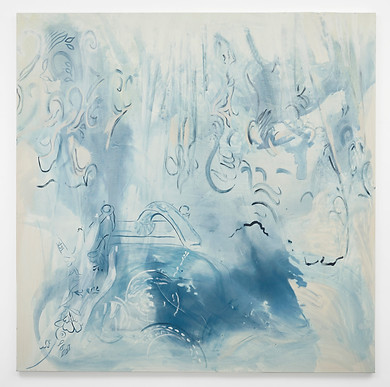
Drawing on the experience of my previous piece and a tutorial with Anna Bunting-Branch, I paid close attention to the negative space or blank space in this painting. Anna suggested that I look at the works of Zeinab Saleh, a Kenyan artist. Saleh is able to evoke a sense of intimacy and contemplation by skillfully steering the 'realm of the blank space' in her compositions (Tate, n.d.). I translated the lessons learned from her approach into a careful 'tug-of-war' of presence and absence in my compositions. By letting go of some control of the canvas, I give blank spaces to tell their own narratives.
Zeinab Saleh, Breeze,2022 (Tate, n.d.)

I was also inspired by Miranda Forrester's work.I find it fascinating how she strategically uses blank spaces to create ambiguity and tension within her narratives. The ambiguity between figure and ground is a mesmerizing concept that I have also attempted to portray in my works (Forrester, n.d.).
Miranda Forrester, There are other ways to be (come) a mother, 2023 (Forrester, n.d.)
Reflecting on my work, my mother's reminder of Asian culture's appreciation for blank spaces opened new doors for my research. In Japanese art, extra white and the space left untouched is known as 'yohaku no bi', a concept derived from Chinese landscape ink wash paintings and further refined by Japanese Buddhist priests (Seattle Japanese Garden, 2016). In 'yohaku no bi, the significance of negative space when conveying depth and emotion is emphasized. Similar to how clouds, mist, and water are often left unpainted, their presence/ absence implied rather than explicitly depicted in these traditional paintings, I strive to imbue my canvases with a similar sense of implied presence and subtle nuance (OpenAI ChatGPT, 2024). This is because intimacy, time, and fragility of human experiences and time are often fleeting, even surreal (Seattle Japanese Garden, 2016). In my opinion, a more gentle approach to presentation better allows me to convey that feeling of intimacy/ time/ fragility. This method of designing compositions is also aligned with the concept of qi in Taoism, where the formless energy from which the universe emanates (Seattle Japanese Garden, 2016).
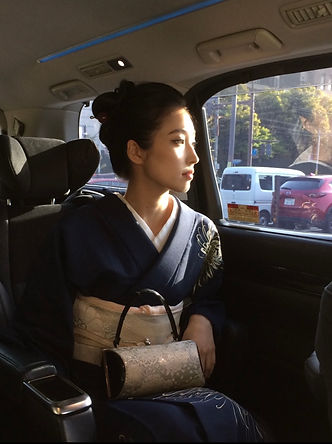
We see the preference for such aesthetic in all aspects of asian culture including fashion, architecture and music. However, even though I take reference from traditional Asian art, I am not interested in recreating traditional Asian artworks. I am more interested in adapting and imbuing specific artistic preferences into contemporary art pieces.
This is a Kimono (traditional Japanese attire). Even in fashion, there is an emphasis on the beauty of the empty space (Giao, 2024).
At this juncture, my external research in collaboration with a silkworm farmer provided a breakthrough that profoundly impacted my artistic practice. I started placing live silkworms onto my canvas so that they can spin silk directly on my canvas.Through this, I hoped to create sculptural-paintings of time and intimate memories.
As explained under 'methods, processes and materials' (please click here), silk is closely linked to my interest in intimacy, memory, time, the ephemeral and fragility of human experiences. I will further elaborate on this (click here), but in summary, silk appears in three primary four within my practice: as a textile, as raw unprocessed threads, as processed silk threads, and as silk fibre. During my external research alongside a silk farmer, I could not help but notice the static yet ethereal quality of silk fibres.
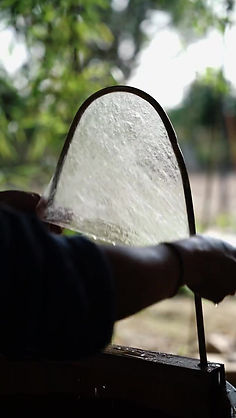
It reminded me of delicate spiderwebs suspended in time.It also dawned on me that the way our memories intertwine with the fabric of our lives, is so similar to how silk fibres delicately weave through time, capturing moments like fragile threads in a vast tapestry.
Video: Silk fibres being stretched
Typically, cocoons have to be stretched into silk fibres, then left to dry before use (Xu, 2024).
I intially attempted to cover my whole canvas by stretching the silk fibre over the surface. However, I soon realized that due to the elasticity of silk fibres, there is a limit to how much it can be stretched

The limits to which silk fibre can be stretched.
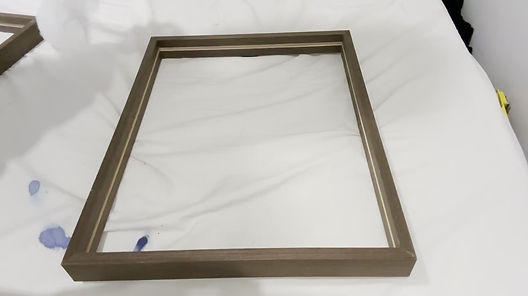
Demonstrating on an unused stretcher how I would stretch silk fibres across paintings completed by memory drawing
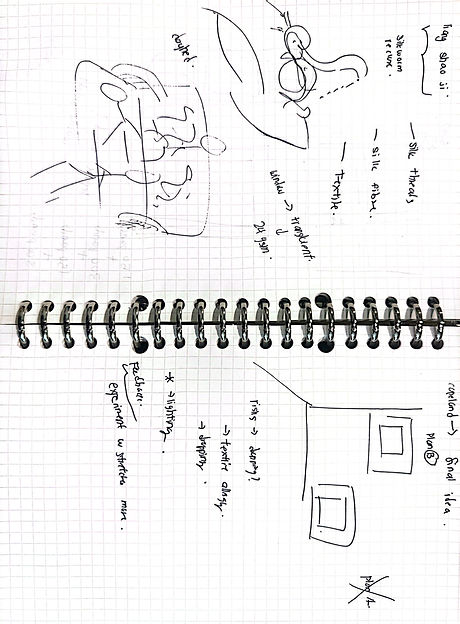
The silk farmer I had been collaborating with for external research suggested that I employ the help of silkworms by allowing them to spin silk on my canvases directly. He suggested that we look into the technique pioneered by Liang Shao Ji.

Liang Shao Ji is a pioneer in the use of silk in non-conventional forms. His works have been exhibited globally, including at Frieze and Art Basel. He was also the one who invented the technique of getting silkworms to spin silk on non-conventional surfaces (The Allure of Matter, n.d.).
Liang Shaoji, Chains, 2022
(The Allure of Matter, n.d.)
Typically, silkworms spin silk into a cocoon around themselves. To get silk worms to spin silk directly onto the canvas, and not spin silk into a cocoon, we had to train the silkworms. It was challenging as it was the first time both the silkworm farmer and I experimented with this technique. The silkworm farmer was more familiar with the traditional method of rearing silkworm to produce silk textile. I researched into interviews and academic papers liang shao ji had participated in . Together with the silk farmer's help, I finally managed to get the silkworms to spin silk directly on the canvas instead of spinning cocoons.
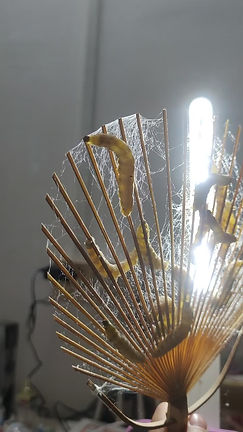
Video: Attempting to train silkworms to spin silk directly onto surfaces instead of forming cocoons. Silkworms behaviour can be influenced by sound, temperature etc. (TTLittlelucky, 2023).
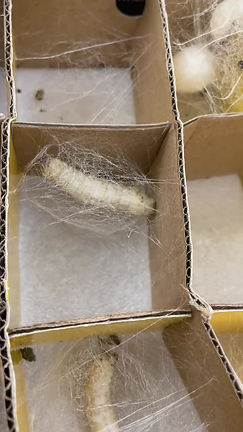
Video : Typical behaviour of silkworms: they usually spin silk around themselves to form a cocoon
In reflection, my biggest regret is not having enough footage. The silkworm farmer reminded me that silkworms prefer to spin silk in the dark, and I do not have a night camera. When it came to finally getting the silkworms to spin silk on my actual canvas, did not want to take any risks. I was worried I would not be able to make it for the Copeland Gallery show; hence, I decided to play safe. After all, there will be opportunities for further documentation in the future.
Reflection:
I was contemplating about the significance of the spinning of silk onto my canvas during my flight back to London.As there was no one around me, I had a conversation with ChatGPT. It was an interesting conversation, and it helped me put my convoluted thoughts into words.These were some of the quotes derived from our discussion:
"Intimate memories, inherently tied to the past, intersect with the silk worm's meticulous weaving, blurring temporal boundaries. This fusion of time not only captivated my imagination but also ignited a desire to delve deeper into the concepts of disappearance and transformation within these fragile memories. By incorporating silk fibers into my creative process, I sought to capture the essence of time's cyclicality and the interconnectedness of past, present, and future without relying on conventional timekeeping methods.
Furthermore, the process of training silkworms to spin silk directly onto the surface rather than into cocoons added an intriguing dimension of intimacy to my work. This departure from their natural instinct to cocoon symbolizes a collaboration between human and nature, a shared effort in the creation of something beautiful and meaningful. It evokes a sense of closeness and connection, as if the silkworms themselves are actively participating in the artistic process, leaving behind traces of their delicate labor. In this way, the act of weaving becomes not only a reflection of time's passage but also a testament to the intimate relationship between artist and medium, human and nature." (OpenAI ChatGPT, 2024).
Supporting work:
***please click to play***
I relied on an interactive conversation with friends and family for this painting. The voice recording of others has been manipulated at their request ( they feel shy to use their own voice).

Forrester, M. (n.d.). Miranda Forrester. [online] Miranda Forrester. Available at: https://www.mirandaforrester.com [Accessed 22 May 2024].
Giao, M. (2024). Instagram. [online] www.instagram.com. Available at: https://www.instagram.com/mikugiao/ [Accessed 21 May 2024].
inshaneats (2024). It’s been a minute. TikTok. Available at: https://vt.tiktok.com/ZSYYh74wQ/.
Lynne, C. (2023). Feeling very nostalgic here. Tiktok. Available at: https://vt.tiktok.com/ZSYYhXyms/.
MoMA (n.d.). Jackson Pollock. One: Number 31, 1950. 1950 | MoMA. [online] The Museum of Modern Art. Available at: https://www.moma.org/collection/works/78386.
OpenAI ChatGPT (2024) ChatGPT response to Esme Tan, 13 May
OpenAI ChatGPT (2024) ChatGPT response to Esme Tan, 15 May
Seattle Japanese Garden (2016). Yohaku no bi: The Beauty of Empty Space. [online] Seattle Japanese Garden. Available at: https://www.seattlejapanesegarden.org/blog/2016/03/15/yohaku-no-bi-the-beauty-of-empty-space.
Tate (n.d.). Zeinab Saleh | Tate Britain. [online] Tate. Available at: https://www.tate.org.uk/whats-on/tate-britain/zeinab-saleh.
The Allure of Matter (n.d.). Liang Shaoji. [online] The Allure of Matter. Available at: https://theallureofmatter.org/artists/liang-shaoji/.
Thomas (2011). Pinang Peranakan Mansion. [online] ContemporaryNomad.com. Available at: https://www.contemporarynomad.com/pinang-peranakan-mansion/ [Accessed 20 May 2024].
TTLittlelucky (2023). 沉浸式吐丝. www.xiaohongshu.com. Available at: http://xhslink.com/VgrigK [Accessed 20 May 2024].
Xu, X.X. (2024). 闺蜜快生二胎,给宝宝做个黄金蚕丝百家被. www.xiaohongshu.com. Available at: http://xhslink.com/HaOggK [Accessed 19 May 2024].
Grammar corrected with ChatGPT