


*Click on the photographs for an in-depth explanation of each painting


Critical Reflection
In Unit 2, I focus on capturing fleeting moments of intimacy while articulating the temporality of the passage of time. In harmony with the ebb and flow of time, I also explore concepts related to disappearance and transformation within the fabric of intimate memories.
Intimacy:
I spent the first day of spring alone ~
It was a Wednesday, and it was unusually sunny. Everyone was out: every bench occupied miles along the canal. It felt peculiar to welcome spring in March. Primavera was always romantically reserved for May, my sentimental disposition always anticipating the dismal truth of T.S Eliot's poem, "The Waste Land": stirring lilacs out of the dead (Eliot, 1922). There were no lilacs yet — too early, but in every ghostly-fair face coming out of hibernation, I saw that faint touch of death being stirred by the gentle rays of sunlight.

That afternoon, my best friend called me to complain that her Tinder date was disappointing, 'lazy intimacy' in her own words. I pondered the notion of intimacy as I listened to my friend reflect on why her Tinder date did not go well. In her words, she "had always dreamed of a run-in with a stranger. The nameless one-night-stand kind", but "that is a false copy of the real thing". I remember agreeing that real intimacy requires knowledge of the mundane or every day . Real and profound intimacy is derived from knowing things that are only to be discovered through the divulgence of everyday's mundanity, the kind of insights that are only to be glimpsed over the sharing of breakfast — seeing the shape of a person by how they have their egg, how much jam they put on their bread. Do you prepare your coffee with a drip? French-press? Moka or perhaps a Percolator?
T.S.Eliot's book cover (W. W. Norton, n.d.)
Intimacy in the mundane/ the every day is also a sentiment that Lauren Berlant, a luminary in cultural theory, has supported. Berlant illuminated the subtleties of intimacy by highlighting the significance of the 'sparest of signs and gestures.' (Pedwell, 2024). She contended that intimacy transcends grand gestures, envisioning it as an 'aspiration for a narrative about something shared' (Berlant, 1998).
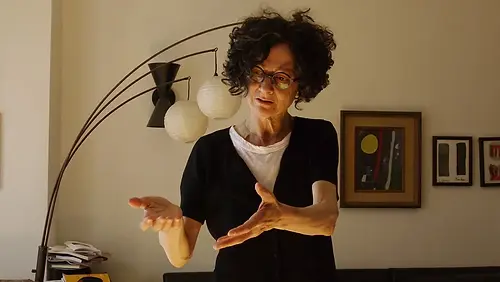
Photo of Lauren Berlant (Casid, 2021)
Based on my understanding, Berlant's reference to the "sparest of signs and gestures" suggests that intimacy can be found in even the most subtle interactions between individuals. These interactions serve as the foundation for deeper connections. This is aligned with my practice. I have always found the most mundane and everyday memories the most intimate. Similar to Berlant's notion of intimacy, I also believe that it is often the subtle nuances of daily life—the fleeting glances, gentle touches, and shared moments—that hold the most profound significance. These seemingly ordinary occurrences, when woven together, form the fabric of intimacy, creating a narrative of shared experiences. Like Berlant's concept of intimacy as an "aspiration for a narrative," I see my work as a means of capturing and preserving these everyday moments, crafting a story that speaks to the individual and collective human experience. (Berlant, 1998).
Zeinab Saleh, a Kenyan artist, is also known to be able to capture the nuances and power of intimacy of everyday life in her work, highlighting the universality and significance of these seemingly small moments in our lives (Wachter, 2024).
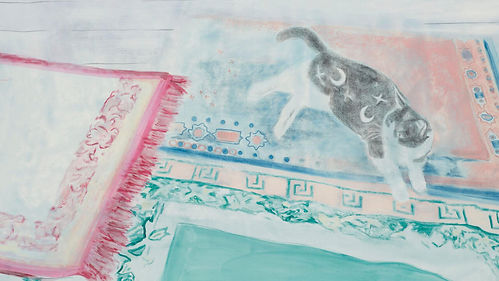
Zeinab Saleh, The sovereignty of quiet, 2024 (Wachter, 2024)
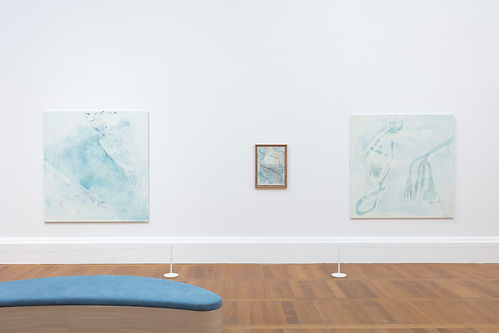
In one of her interviews, Saleh mentioned, "The starting point is a real space, but it becomes more fluid, and the forms kind of morph and mesh into each other."(Camden Art Centre, 2021). This statement spoke to me. Hence, I decided to go and see her work in person at Tate. When I stepped into the hall featuring her work, I was overwhelmed by the mesmerizing blend of realism and abstraction in her canvases, where recognizable elements dissolved into ethereal shapes and textures. Seeing her work in person made me understand what she meant in her interview. Just as her artwork transcends the confines of physical space, delving into the intangible aspects of human experience, intimacy defies simple categorization and containment, too. This fluidity and transformative quality infuse her work with a sense of intimacy, inviting viewers to contemplate the intricate interplay between the external world and our internal landscapes. It made me consider intimacy in my work. I have always subconsciously recognized that intimacy is not always static; it can evolve, shift, and intertwine with other emotions and experiences. This shows in the creation process of my work, where my memory drawing is supported by prompts and supplemented with my imagination or elements in the current space I inhabit.
Saleh's exhibition at Tate (Politi, 2024)
Additionally, seeing her works in person allowed me to see her brushstrokes up close. They were fluid, spontaneous, and expressive. This starkly contrasts the brushstrokes I am used to, making me ponder if I am too conservative in my strokes.
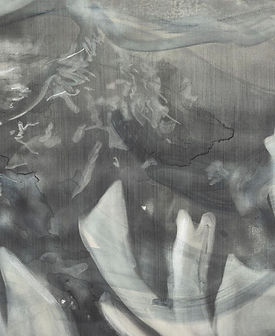
Close up of Saleh's brushstrokes
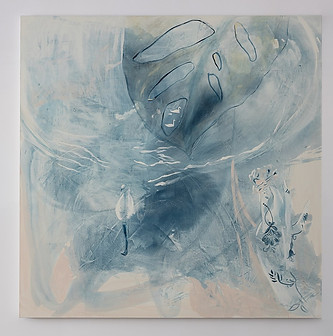
Zeinab Saleh, Slow Swim, 2022
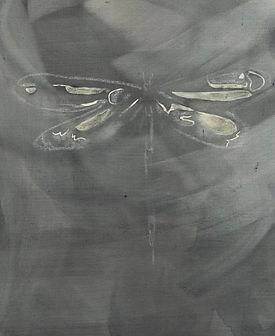
Close up of Saleh's brushstrokes
During a group critique, one of my classmates, Ernesto reminded me of a quote by Momtaza Mehri, an award winning poet and essayist, who once mentioned that "Ties of kinship are unruly, uncontainable and irrepressibly prone to spillage" (Mehri, 2021). This suggests a sense of fluidity and unpredictability in human relationships. This idea can be linked to the brushstrokes. Just as kinship ties defy simple categorization, dynamic, spontaneous, and free-flowing brushstrokes can be used to reflect the complexities of human connections.
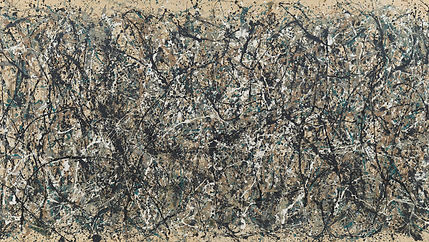
Artists like Jackson Pollock and Willem de Kooning employed unrestrained brushwork in their abstract expressionist paintings (Annie Ochmanek, 2016). Their energetic and unrestrained brushstrokes captured the intensity of emotion and the fluidity of human experience (Corder, 2012). After careful consideration, I pondered whether to advance beyond the technique of overlapping lines and venture into bolder strokes. Gavin Edmonds's insightful comment during his visit to our show at Copeland Gallery echoed in my mind: "You will never know until you try.".
Jackson Pollock, One: Number 31, 19501950 (Annie Ochmanek, 2016)
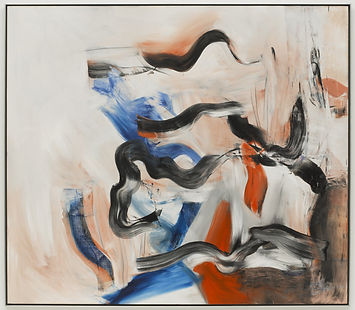
Willem de Kooning, Untitled IV, 1982 (Corder, 2012)
The aforementioned discussion points become evident in The National Gallery of Denmark's 2016 exhibition "Closer – Intimacies in Art." This exhibition, curated by Mikkel Bogh, explores 200 years of artistic practice (1730 to 1930), delving into intimacy in art (National Gallery of Denmark, 2016).
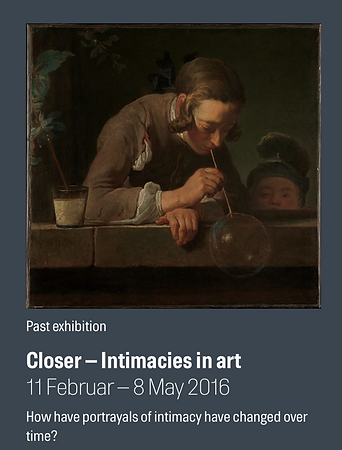
What I find particularly intriguing is the exhibition's departure from traditional conceptions of intimacy (Bogh, 2016). It challenges the notion that artworks must directly engage with the viewer to convey intimacy. Instead, the exhibition suggests that profound intimacy can be conveyed when the subject appears unaware of the viewer's presence (Bogh, 2016). This deviation from conventional norms profoundly resonates with me, prompting a reevaluation of how intimacy can be depicted and conveyed.
Advertisement for 'Closer-Intimacies in art' (National Gallery of Denmark, 2016)
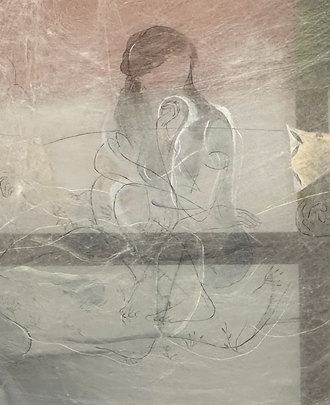
In my works, I endeavor to encapsulate intimate moments shielded from external scrutiny. By portraying faceless subjects engrossed in their personal realms and inanimate objects, I aim to evoke a profound connection with the viewer.
My work
Bogh raised intriguing questions about the viewer's role in experiencing intimacy within artworks (Bogh, 2016). When the subject seems unaware of being observed, the intimacy of the artwork intensifies, suggesting that the voyeuristic viewpoint itself can be intimate (Bogh, 2016). However, in my opinion, this proposition is complex and contentious, as illustrated by George Hendrik Breitner's photography, whose works clearly targets the privileged heterosexual male viewer (AnOther, 2016).

In this instance, intimacy intertwines with the thrill of revelation, as viewers are positioned as clandestine observers stumbling upon a scene typically kept hidden (AnOther, 2016). The intimacy between the subject is exposed unbeknownst to them, and "is not being shared or reciprocated by the viewer's voyeurism" (AnOther, 2016).Their intimacy remains distinct from the viewer's voyeuristic encounter. This lays the foundation for the complex interplay between perception, and human connection.
Two Women on Bed, 1889-1915,George Hendrik Breitner (AnOther, 2016)
This brought to mind Anna Bunting Branch's insightful guidance on envisioning one's artwork within a museum context. She emphasized the distinction between simply capturing intimate moments and effectively communicating the essence of intimacy to one's audience.
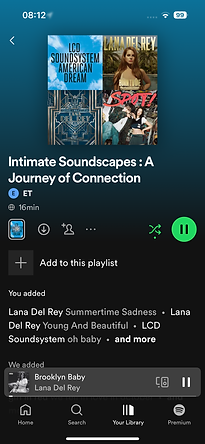
Anna articulated that evoking feelings of intimacy extends beyond the confines of the painting itself; it can also encompass elements such as music, labels, lighting, and more. It was a fascinating idea. Recently, with the context of envisioning my paintings in a museum, I created a Spotify playlist, "Intimate Soundscapes: A Journey of Connection".
Intimate Soundscapes: A Journey of Connection
This Spotify playlist proved useful when I started picking up meditation yoga in London in recent months. Meditative yoga has become a profound journey of self-discovery for me. In these quiet moments of reflection, I've found that repressed memories often rise to the surface, like fragments of a forgotten past seeking to be acknowledged. It is as if the stillness of meditation creates a fertile ground for these memories to emerge, free from the distractions and noise of everyday life. Reflecting on my past experiences with therapy, I recall the years spent with a psychiatrist, where I struggled to open up. Yet, with meditative yoga, I can gently revisit memories at my own pace without the pressure of verbal communication.
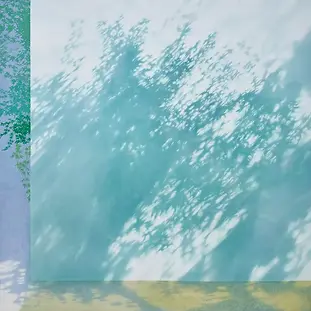
Park Yunji,Where you stayed, 2024
(Artsy, n.d.)

(Artsy, n.d.)
Meditative yoga has also influenced my artistic preferences. I find myself drawn to the tranquility and serenity depicted in artworks, seeking solace in their peaceful qualities. One example is Park Yun Ji's paintings (Artsy, n.d.). The subtle interplay of light and shadow and Park Yun Ji's masterful use of color and form imbue the paintings with a sense of quietude and introspection, inspiring me to explore similar themes in my work (Artsy, n.d.).
In conclusion, the most tranquil art sometimes has an inherent intimacy that resonates deeply with me. This intimacy arises from the artist's ability to evoke a sense of quiet introspection and emotional connection through serene compositions and subdued palettes. This intimate engagement often occurs in moments of quietude, where the absence of distraction allows for a deeper exploration of one's thoughts and feelings.
Time:
Given that the realm of the intimate is so flighty, so vulnerable to fickle exposition and soul-sapping examination, I wondered how I could explore concepts of disappearance and transformation by marking the passing of time. Beautifully put in words by Rita Trindade for ThroughObjects :
"Time. This abstractly defined human metric: the perception that time passes faster or slower, that it is spent well or poorly. Time marks the ephemeral, the provisional. As Saint Augustine (354-430) wrote in Confessions, Book XI, it is possible to establish that temporality belongs to humankind and does not have attributes of eternity. Time can't measure eternity since the latter is above temporality. But what if we could make the question of temporality more evident to our eyes? What if we could make the temporary visible?" (Objects, 2022).
Under 'Methods, processes and materials', I have covered how and why I found my answer in silk.
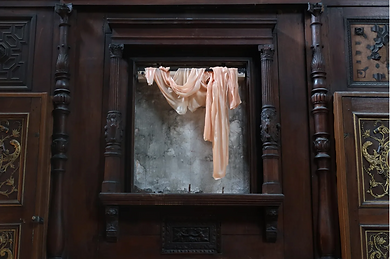
Juliette Minchin, Relique, Chapelle des Beaux-Arts de Paris, 2021 (Minchin, n.d.)
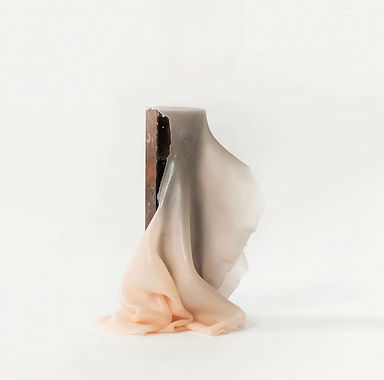
Juliette Minchin is another artist who has found the answer to time in materiality.
To her, Wax is a material that can be recycled infinitely. It can be reborn endlessly through re-melting and creating a new piece (van den Eijkel, 2024). It is a cycle. When I saw her work in France, I was awed. Her work pushed me to consider a way in which I can present my work. Not immediately influential as I browsed the works, but something lingered.
The repetition of drapes in Minchin's work and the reinterpretation of antique drapery in contemporary space spoke to me. I have always been fascinated by the transformation in architectural spaces: the bare walls at construction sites before they are clothed with their 'skin,' the vast fabrics that protect 13th-century churches during restoration work, and the remains of a skyscrapper reduced to a carcass after a fire. Not because I am particularly interested in architecture but because of the sacred forms and rites invented by humans in response to the fear of death or to lead a spiritual life, give meaning to life, or even reassure ourselves. I am not talking about religion but a shared vision regarding the cyclicality of yin and yang, of life and death. I considered this idea in relation to my paintings and my existing frames. Endless variations are ongoing evolving dialogues with one another. Furthermore, how the repetition can signal time being at a standstill, particularly when set in the context of traditions.
Juliette Minchin's work (Minchin, n.d.)
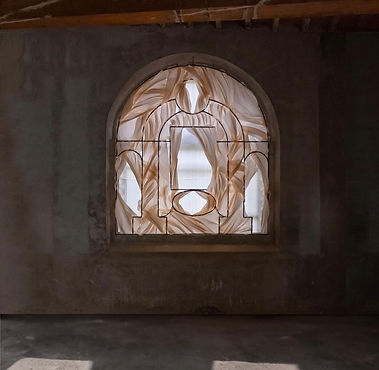
Juliette Minchin's work (Minchin, n.d.)
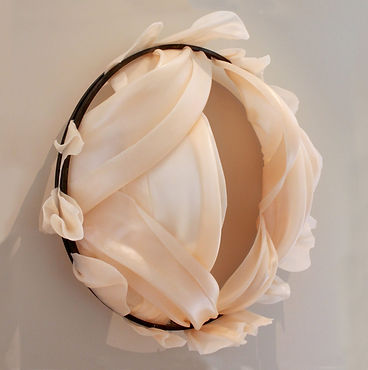
Juliette Minchin's work (Minchin, n.d.)
I made a table analyzing the difference between my practice and Minchin's. This helps me think from her perspective and understand her as an artist I admire and a fellow individual with similar research interests.
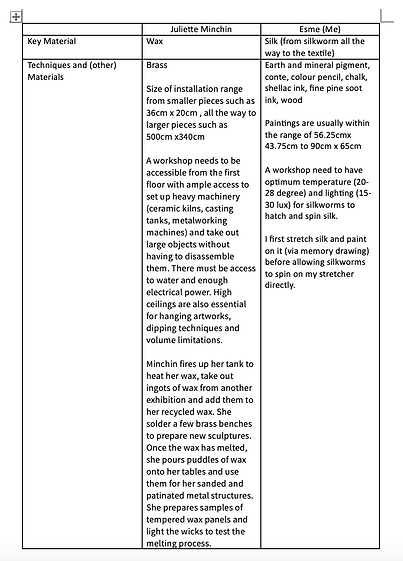
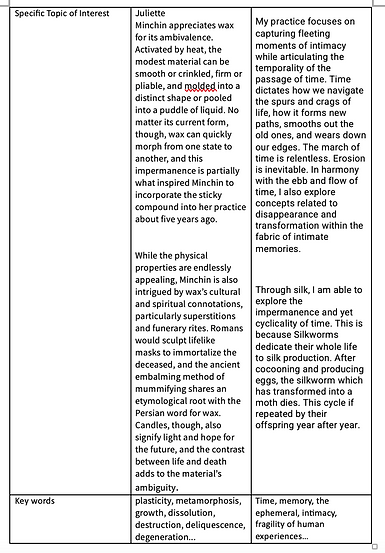
I had the opportunity of meeting a technician who had worked with Juliette Minchin, even though they did not spend much time together. However, in the short period they did interact, the technician could not help but notice Minchin's profound attachment to her materials. They observed how Minchin handled each piece with care and precision, treating the Wax like a precious treasure. This attention to detail and reverence for her materials spoke volumes about Minchin's commitment to her craft and deep connection to the artistic process.
During my research into Minchin and conversations with people around her, I have realized the importance of delving deeper into the motivations and methods behind an artist's practice. While we often encounter famous names in textbooks and on social media, understanding the intricacies of their work can offer valuable insights into the creative process. I realized that it is often easy to put artists we admire on a pedestal, but they are also human at the end of the day. They are also motivated by a cause and have to deal with setbacks in their creative endeavors.
Exploring the concepts of disappearance and transformation within the fabrics of intimate memories is complex. This exploration delves into the ephemeral nature of existence, the inevitability of change, and the profound effects of time on individuals, societies, and the world. Throughout history, many philosophers have attempted to put words to this exploration.
Sartre's notion of "bad faith" reflects individuals' tendency to deny the reality of their finitude (Churchill and Reynolds, 2014). By conforming to societal expectations or roles, individuals may engage in self-deception to avoid confronting their existential reality. This denial of one's mortality mirrors the way intimate memories can disappear or be transformed over time, as individuals may repress or distort painful recollections to maintain a sense of psychological comfort (Churchill and Reynolds, 2014).
On the other hand, Nietzsche's concept of the "eternal recurrence" challenges individuals to imagine living their lives in a way that they would willingly accept the eternal repetition, encouraging them to engage authentically with each moment( Löwith, 1997). This perspective offers a profound insight into the transformative power of intimate memories, suggesting that by embracing their fleeting nature, individuals can find purpose amidst life's inevitable changes.
I am reminded of Dawn Ng's recent series, which underscores the ephemeral nature of temporality and beauty through her innovative exploration of melting blocks of pigmented ice (Wood, 2022). I am particularly drawn to her emphasis on the transformative process (Wood, 2022). If the pigment ice block is a metaphor for a clock, and the 'now', the gradual metamorphosis of the materials speak to a profound engagement with the passage of time in the context of intimate memories and the impermanence of existence (Wood, 2022).
Dawn Ng - Avalanche II
(Strumpf, 2022)
Much like the philosophies of Sartre and Nietzsche, Ng's work helps me appreciate the intricate interplay between disappearance, transformation, and the fabric of intimate memories as they shape our experiences and perceptions of the world. This inspires me to further explore the intersection of temporality, beauty, and existential inquiry.
Annie Ochmanek (2016). Jackson Pollock. [online] The Museum of Modern Art. Available at: https://www.moma.org/artists/4675.
AnOther (2016). Peep Show: A Tender Exploration of Intimacy in Art. [online] AnOther. Available at: https://www.anothermag.com/art-photography/8303/peep-show-a-tender-exploration-of-intimacy-in-art [Accessed 22 May 2024].
Artsy (n.d.). Park Yunji | 2:12pm (2024) | Available for Sale | Artsy. [online] www.artsy.net. Available at: https://www.artsy.net/artwork/park-yunji-2-12pm [Accessed 22 May 2024].
Artsy (n.d.). Park Yunji | Where you stayed (2024) | Available for Sale | Artsy. [online] www.artsy.net. Available at: https://www.artsy.net/artwork/park-yunji-where-you-stayed-8 [Accessed 22 May 2024].
Berlant, L. (1998). Intimacy: A Special Issue. Critical Inquiry, 24(2), pp.281–288. doi:https://doi.org/10.1086/448875.
Bogh, M. (2016). Closer – intimacies in Art 1730-1930. SMK.
Camden Art Centre (2021). Zeinab Saleh on Softest place (on earth) at Camden Art Centre, 2021. [online] YouTube. Available at: https://youtu.be/ZwFIp_OPbDc?si=V2UcZnp_Taz1boxc [Accessed 22 May 2024].
Casid, J. (2021). They Did What They Could Do at the Time: Thinking with and after Lauren Berlant. [online] ARTnews.com. Available at: https://www.artnews.com/art-in-america/columns/lauren-berlant-remembrance-jill-casid-1234599248/ [Accessed 22 May 2024].
Churchill, S. and Reynolds, J. (2014). Jean-Paul Sartre : key concepts. Oxfordshire, England ; New York, New York: Routledge.
Corder, R. (2012). Willem de Kooning. [online] Flickr. Available at: https://www.flickr.com/photos/rocor/7343780912 [Accessed 22 May 2024].
Eliot, T.S. (1922). The Waste Land. [online] Poetry Foundation. Available at: https://www.poetryfoundation.org/poems/47311/the-waste-land.
LöwithK. (1997). Nietzsche’s philosophy of the eternal recurrence of the same / Nietzsche’s philosophy of the eternal recurrence of the same. Berkeley: University Of California Press.
Mehri, M. (2021). File Note 136: Zeinab Saleh - Camden Art Centre. [online] camdenartcentre.org. Available at: https://camdenartcentre.org/file-notes/file-note-136 [Accessed 22 May 2024].
Minchin, J. (n.d.). Juliette Minchin / Artist. [online] Juliette Minchin. Available at: https://www.julietteminchin.fr [Accessed 22 May 2024].
National Gallery of Denmark (2016). Closer – Intimacies in art. [online] SMK – National Gallery of Denmark in Copenhagen (Statens Museum for Kunst). Available at: https://www.smk.dk/en/exhibition/closer-intimacies-in-art/ [Accessed 22 May 2024].
Objects, T. (2022). Time, Residue & Memory. INTO AIR by Dawn Ng. [online] Through Objects. Available at: https://through-objects.com/blog/time-residue-memory-into-air-by-dawn-ng/ [Accessed 22 May 2024].
Pedwell, C. (2024). Carolyn Pedwell: Introduction: Lauren Berlant and Media Theory. [online] Media Theory. Available at: https://mediatheoryjournal.org/2024/02/16/introduction/ [Accessed 22 May 2024].
Politi, G. (2024). From Wind to Signs. A Conversation with Zeinab Saleh |. [online] Flash Art. Available at: https://flash---art.com/article/zeinab-saleh/ [Accessed 22 May 2024].
Strumpf, S. + (2022). Dawn Ng - Avalanche II. [online] Vimeo. Available at: https://vimeo.com/722442099 [Accessed 22 May 2024].
van den Eijkel, W. (2024). The studio of... Juliette Minchin | Gallery Viewer. [online] galleryviewer.com. Available at: https://galleryviewer.com/en/article/2266/the-studio-of-juliette-minchin [Accessed 22 May 2024].
W. W. Norton (n.d.). The Waste Land. [online] wwnorton.com. Available at: https://wwnorton.com/books/9781324093008 [Accessed 22 May 2024].
Wachter, E.M.D. (2024). The Quiet Sovereignty of Zeinab Saleh. [online] Frieze. Available at: https://www.frieze.com/article/zeinab-saleh-2024-review.
Wood, B. (2022). Dawn Ng explores the passage of time through colour at a Marylebone chapel. [online] The Spaces. Available at: https://thespaces.com/dawn-ng-into-air-marylebone/ [Accessed 22 May 2024].
Grammar corrected by ChatGPT