


In this section, I will do a walkthrough of how I investigate the process of memory formation.
I am currently exploring the process of memory formation through depictive doubling, relying on a technique called 'memory drawing'.Memory drawing encompasses creating a visual memory bank via the daily observation of objects, people, and events (Wider, 2018). A drawing produced using the objects, places, and situations from our memory bank is called a memory drawing. This is a new technique for me. I became interested in memory drawing through the late Kim Jung Gi , who is also known as the Master of memory drawing (Mattei, 2022).

This is a picture of Kim Jung Gi drawing (Kim Jung Gi US, 2017).
When Kim Jung Gi draws, he starts by deciding what he wants to draw. He then creates another 'me' in his mind who will be traveling through the space of what he wants to draw (Proko, 2019). By sending a bunch of mini' me's into the canvas, he decides which perspective has the best impact and composition. Subsequently, he draws from his memory bank to determine the equipment, vehicles, buildings, animals, or plants that would fit the situation (Proko, 2019). This resonated with me. Like Kim Jung Gi, I find that when I recall distant memories, I also tend to take a more third-person perspective, as if observing a scene from a movie. In an interview with Proko, Kim Jung Gi also mentioned that he sees objects transparently (Proko, 2019).
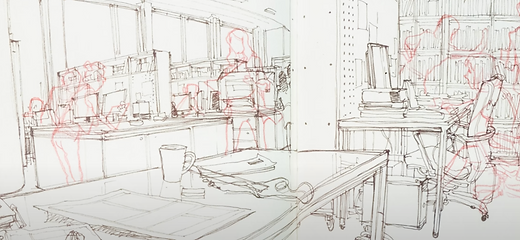
Example of Kim Jung Gi's drawing (Proko, 2019)
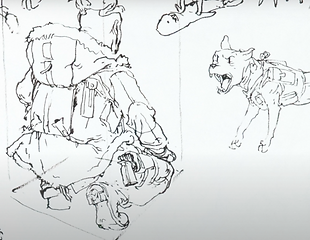
Example of Kim Jung Gi's drawing (Proko, 2019)
Kim Jung Gi's method of drawing transparently resonated strongly with me, too. As a Peranakan, and a unique aspect of Peranakan architecture is the layering of space. Hence, recalling objects and spaces through a lens of transparency helps my memory formation process.
When I first started, I decided to borrow from his technique to trace my memories. However, I soon realized that something was lacking. As Kim Jung Gi has built a memory bank of images with the intention of using them in his practice for several years, he can recall with clarity what the object is supposed to look like (Soul Sonica, 2023). However, my visual memory bank was considerably lacking, and many images I drew were incomplete. Additionally, Kim Jung Gi was not focused on re-creating specific events but on loosely using his memory bank's images to create imaginative narratives. This contrasted with my goal of investigating the process of memory formation via recalling past events. Rather than determining "the equipment, vehicles, buildings, animals or plants would fit the situation" like Kim Jung Gi, I should focus on recalling the equipment, vehicles, buildings, animals or plants that truly existed during that time(Soul Sonica, 2023). This created a gap in my practice as I struggled to fill the gap in my memory.
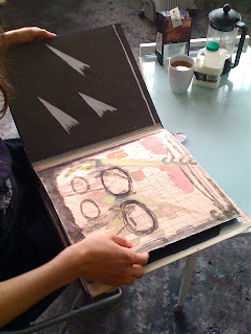
As Phoebe Unwin ( a key artist in this subject area) puts it perfectly, our mind "operates more like sketchbooks than cameras" (Casey, n.d.).We tend to "bleach out certain moments while embedding incidental details" (Casey, n.d.). She uses sketchbooks as a "clutch" in her practice of painting from memory. Phoebe “keeps a diary-sketchbook of drawings and colors, amalgamating, accumulating and testing ideas, before moving to the canvas”(Amanda Wilkinson, n.d.). My process of mapping memory formation would not be authentic if I relied on pictorial clues such as sketches or photographs. However, Phoebe Unwin's words introduced the possibility of relying on non-pictorial clues such as diary entries, conversations with people who experienced specific events with me, or even smell to fill my memory gaps.
Photo of Phoebe Unwin's sketchbook
Putting theory into practice
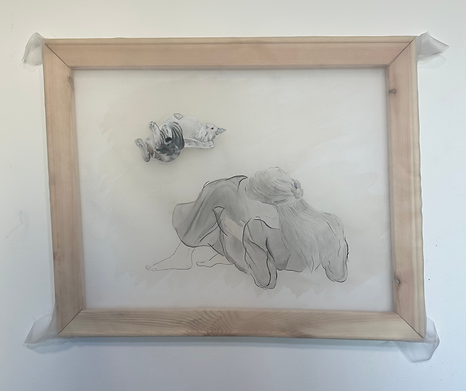
Using this painting as a starting point, I remembered when my family was cat-sitting for a friend. There was no particular reason I chose this memory apart from the fact that I felt like I had a memory bank to pull from. This was my first successful painting on silk. As silk was a canvas I had not used previously, I was particularly unfamiliar with the process of working on silk. I was more focused on mastering silk as a canvas rather than the composition of the painting. I will further elaborate on my interest in the language of silk under the materials section.
cat-sitting
2024
earth and mineral pigment, fine pine soot ink on silk
51cm x 41cm
-
I started by recalling and drawing the particular memory of cat-sitting for a friend without any prompts. My most vivid memory was of the cat, so I started by drawing the cat. I then tried to remember what was around the cat. It came to me that mother was home that day. I remembered that at that time, Mother was home. That was all I could remember. I consider this the first depiction.
-
Subsequently, I pulled out my diary entry from that day. In this painting, I use my diary entry as a prompt. However, apart from diary entries, non-pictorial prompts such as screenshots of texts, conversations and even smells aid me in tracing my memory. This was what I wrote in my diary:
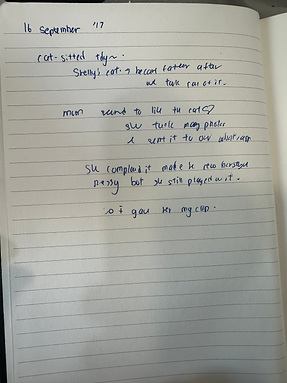
I slowly remembered my mom's hairstyle, her motion, etc. I proceeded to map my memory formation process by adding layers of lines and colors to my paints as I moved. Interestingly, the traces of both the absent and the present helped me recall previously forgotten memories. As I slowly layered the memories onto the canvas, it helped trigger further memories. Hence, even though the final product is a single painting, I consider this the second depiction. This is because I use the first depiction to prompt myself to trace more memories. The outcome is layered compositions like this.
Diary entry of the day we cat-sitter
Overall, I was happy to get the hang of silk as a painting canvas finally. Even though I am still clumsy with silk, at least I am getting the pigments where I want them to be. However, I also realized that I looked at too many works of artists (etc., Aatchin and Kim) who also practices memory drawing in their practice. Their works, imagery, and drawing formulas increasingly became part of my memory bank. Hence, I can see the shadow of their art style in my earlier pieces. Moving forward from here, I reorganized my memory bank and took a break from looking at the works of others.
*under others , I engage in a conversation about the difference between painting and drawing
Casey, G. (n.d.). Phoebe Unwin - George Vasey. [online] georgegvasey.com. Available at: https://georgevasey.com/writing/phoebe-unwin/ [Accessed 24 Jan. 2024].
Kim Jung Gi US (2017). Kim Jung Gi Sketch Collection, News, and More! [online] Kimjunggius.com. Available at: https://www.kimjunggius.com.
Proko (2019). How to Draw like Kim Jung Gi. [online] www.youtube.com. Available at: https://youtu.be/DmqFbgKWoao?si=JuStnyEi8mjvx2y0 [Accessed 25 Jan. 2024].
Soul Sonica (2023). Kim Jung Gi’s Memorizing Method: Draw What You Remember Without Reference, Check Reference, & Repeat. [online] www.youtube.com. Available at: https://youtu.be/yx6dbybn-rk?si=04TXFN8Tw3YaXQfb [Accessed 24 Jan. 2024].