


*Click on the photographs for an in-depth explanation of each painting


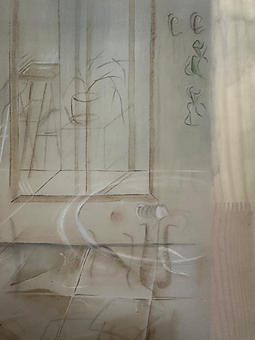
Sunrise, Troubled Hearts
Title: Sunrise, Troubled Hearts
Material: Earth and mineral pigment, chalk, color pencil, conte, and shellac, on silk.
Size: 53.75 cm x 43.75 cm
Year: 2024
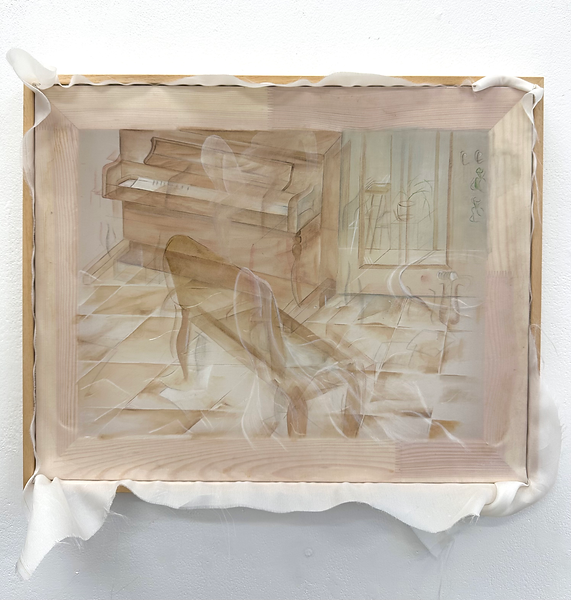
My practice shifted after the Easter break to focus on capturing fleeting moments of intimacy while articulating the temporality of the passage of time. In harmony with the ebb and flow of time, I also explore concepts related to disappearance and transformation within the fabric of intimate memories.It was also after the Easter holidays, I had a breakthrough in my understanding of materiality (which I will elaborate below).
Under 'methods, processes and materials', I explain why there was a shift in my research direction, as well as why I am interested in intimate moments.
The first batch of painting after this development in my practice was created for the Copeland Gallery show (unit 2). This set of work created for the Summer Show was the second time I attempted this method of created paintings. A summary of the process of creating this painting (will be further elaborated in other sections):
memory drawing (without prompt) -> memory drawing (with prompt)-> place silkworms on the canvas to spin silk
As with past works, I started this painting by delving into my memories. While post-Easter, I want to expand my practice beyond understanding the process of memory formation, memory drawing remains an essential aspect of my practice. As I recall details of particular moments, memory drawing becomes a pathway for me to suspend time and re-immerse myself in the intimate essence of those experiences (OpenAI Chat
GPT, 2024).It is more than just capturing the visual elements. The process creates a medium for me to reconnect with the intimate emotions accompanying those moments.Every brushstroke becomes a tactile endeavor into the contours of human connection and the delicate nuances of such intimate yet fleeting experiences.
Details:
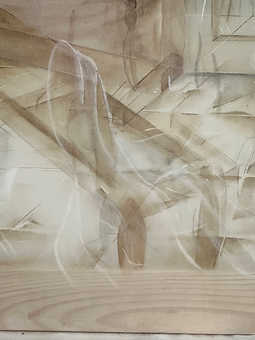
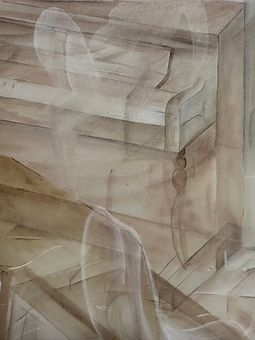
I experimented with double imagery in this painting, depicting objects as if they appear multiple times. This effect arises from the variations between my initial memory drawing and subsequent layers painted with prompts. I chose this technique because I like the softness it gives my paintings aesthetically and because it imparts a sense of stasis to the canvas, reminiscent of the textured quality found in DV tapes. Through this, I aim to enhance the feeling of nostalgia conveyed through my canvases. Unpredictably, I find resonance in Yoora Lee’s fuzzy canvases (Thomas, 2022), n.d.). In my opinion, the fuzzy quality in Yoora Lee's works evokes analog television and contrasts with the 21st-century modern technology she often depicts. This heightens feelings of nostalgia, which I hope to achieve, too.
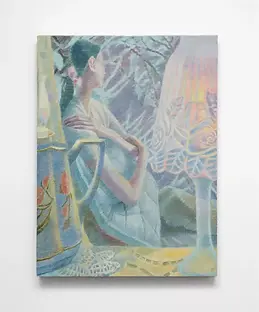
Yoora Lee: Snowy Spring, 2023
(Thomas, 2022)

Yoora Lee: Best Part, 2021
(Thomas, 2022)
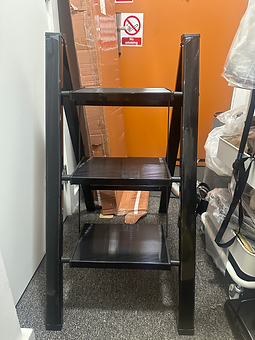
Elements from spaces I currently inhibit often fill in gaps in my memories when recreating scenes from the past. For instance, the ladder shown in my painting is not from my memory. I acquired it upon moving to London. As I completed this piece at home, it found its place in my painting. In a strange way, blending the past and present encompasses the transient nature of intimate memories. When the two boundaries blur, it reflects the ephemeral nature of memories.
Reflections:
Embarking on this painting presented me with a series of challenges to overcome. It marked my first foray into working on a larger canvas, a departure from my usual preference for smaller-scale pieces. Through trial and error, I explored different stretching techniques, experimented with compositions, and intentionally embraced reductive techniques.
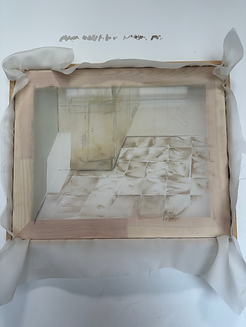
Experimenting with compositions
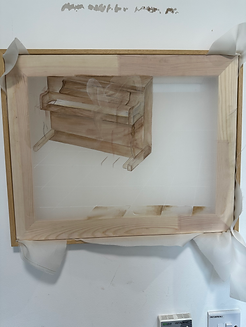
Experimenting with compositions
The conventional stretcher bars I had been using posed limitations on applying thin pigment, colour pencil etc, particularly evident on delicate silk due to its thinness.
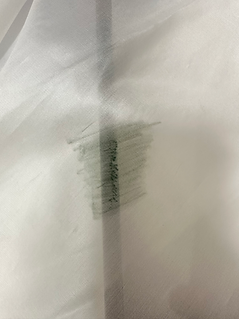
To address this challenge, I made the note to transition to exhibition bars as stretchers for future pieces.However, this revelation came after I had already placed an order for three sets of tray frames and stretcher bars. With budget constraints in mind, I had to make do with the existing stretchers I had on hand for unit 2 of my work. Despite the initial setback, this experience underscored the importance of adaptability and resourcefulness in the creative process.
With regular stretcher bars, there will be a prominent line when painting on silk
Delving into the scale and immersive potential of my painting sparked a contemplative journey into presentation formats. These reflections unveiled a striking contrast between memories' raw, unfiltered essence and the structured finality of compositions. A sense of dissatisfaction arose within me regarding the density of this particular painting, which seemed to stifle the ephemeral quality inherent in intimate memories.
Supporting work:
***please click to play***
As mentioned above, in Unit 2, I continue with the technique of memory drawing. However, the most significant difference is that I rely on both pictorial and non-pictorial prompts for this unit.
For this painting, I voice-recorded my conversation with my mother and relied on prompts from old tapes and photographs. Some of the media files were from my father, some shared with me by friends, and some from other sources.
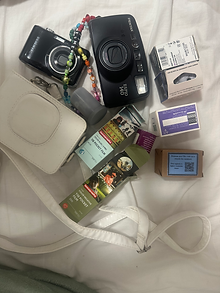
Some of the vintage cameras I brought with me to London
I have a hobby of collecting vintage cameras and camcorders, some of which include the previous owner's film or memory card. While unsure how ethical it is, I occasionally come across aesthetically pleasing/meaningful photos or videos. Although my work focuses on personal memories, seeing life through the lenses of others is intriguing and subtly influences my art. I cannot pinpoint exactly how, but this external perspective enriches my creative process.
I do not work with sketches as I use memory drawing. In a way the sketching process is already my painting process.
With regards to methods, process and materials, this painting retains the methods, processes and materials from unit 1 (here & here) (my practice changed only after Easter).
Studio Diaries:
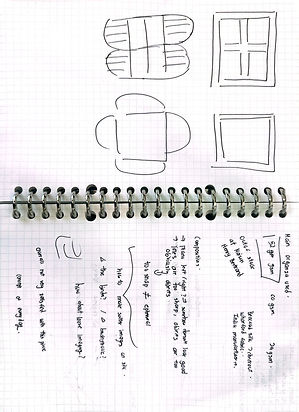
I enjoyed jotting down thoughts and feedbacks in my studio diary.Some quotes that were in my diary:
“Should I start playing with frames in my work? I feel like framing is an important part of my practice. However, framing in London is so expensive. I suppose I could make some on my own but I am not really a fan of woodwork.Anyways, I think it would be cool to make frames inspired by windows in grandma’s house.”
“I wonder where I can find another supplier for 52 gsm organza in London. I have looked at suppliers globally but there seems to be a shortage. I must remember to stock up when it is back in stock”
“It would be nice for the imagery to be softer.I hope to capture movement, a snapshot, and sentiments of unreliability (which aligns with the unreliability of memory).
Will softer brushstrokes work? Or should I experiment with layering of fabrics?”
I also made a list of memories, I am interested in exploring in the future.
“Too many mistakes in this piece, but it is silk so I cannot change anything.Sometimes, I wonder if mistakes are actually better for the piece.Does it really matter that everything is not perfect?
It is my first time experimenting with so much color on silk. I do not think I like it as much as the last painting.
The next piece, I would like to experiment more with the negative spaces in canvases”
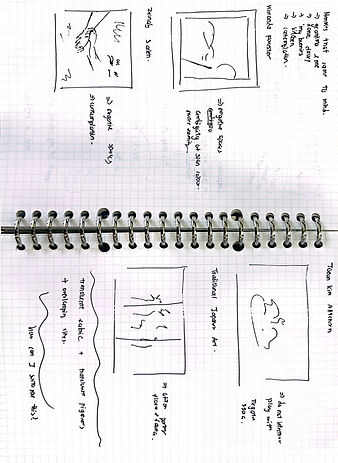
I had been learning more about the concept of negative spaces in various cultures. I made some sketches of some memorable paintings with negative spaces (such as miranda forrester, and Zeinab Saleh).
"I noticed there is a running theme of translucency that I prefer aesthetically ( translucent fabric, translucent lines, translucent pigments and negative spaces.I can utilise this to bring across relevant emotions in my paintings more vividly."
I am very cautious about the cleanliness of my palette when painting. Because silk is a very translucent fabric. When my palette is messy, it shows up very obviously on my canvases. The technician recommended I use separate color mixing dishes instead.
_1.jpg)
Millbank show-Curation & Context :
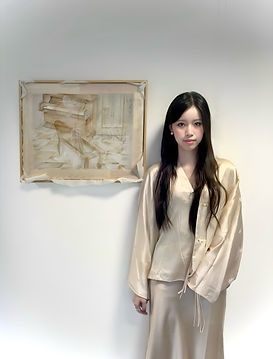
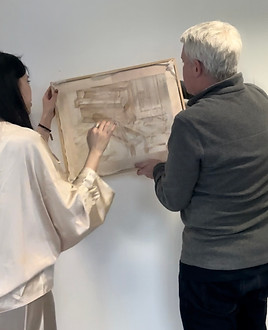
The one-day pop-up show at Millbank was my first exhibition in London. It provided a platform for experimentation. I signed up for the curation team because I was curious to know whether the curation process in London differed from Singapore.
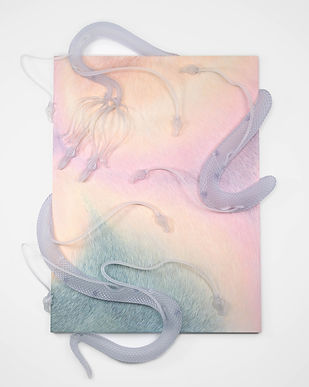
During the Millbank show, I received feedback that I could consider taking the sculptural aspect of my work further. I felt it was interesting and decided to look into it. During my research, I came across artists like KV Duong and Anastasia Komar, who formed the basis of my understanding of sculptural paintings. Duong's dynamic and bold use of mixed media (especially textiles) to explore themes such as identity demonstrated how powerful and evocative sculpture-paintings can be (Duong, n.d.). Similarly, Komar's works highlighted the ability of three-dimensional art to convey complex narratives (Management, n.d.). After the Millbank show, I hoped to expand my artistic practice, integrating the tactile and spatial qualities of sculpture to enrich the exploration of intimate memories and transformation.
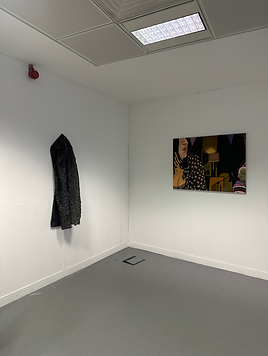
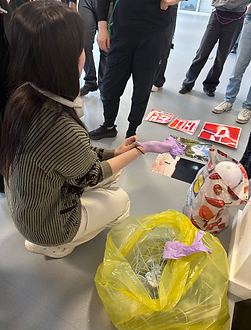
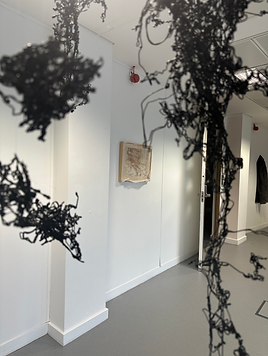
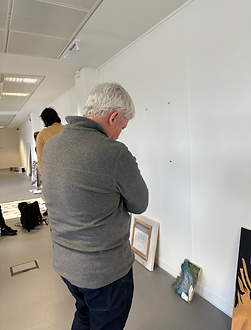
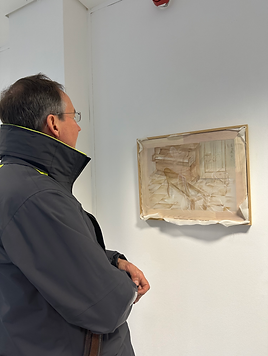
Espacio Gallery-"Impromptu"
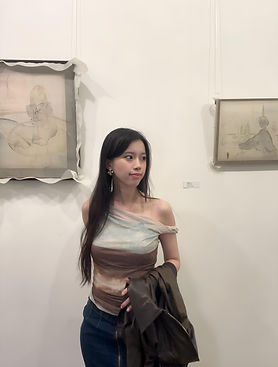
Me with the works I exhibited
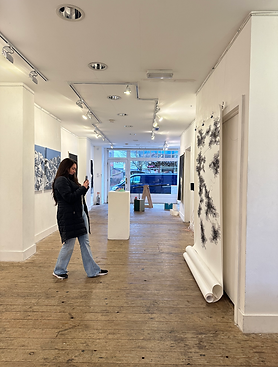
Gallery view
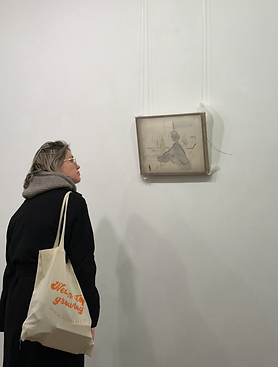
An audience looking at my painting
"Impromptu" was an exhibition organized by Jonathan Hillson, which granted us significant autonomy in curation. Artists working with various mediums, from painting to printmaking, participated. This allowed me to meet people from varying backgrounds, some of whom have progressed to become friends. The variety of artworks exhibited also prompted us to consider how to guide the viewer's eyes and create an immersive experience for visitors through the interplay of works in diverse mediums.
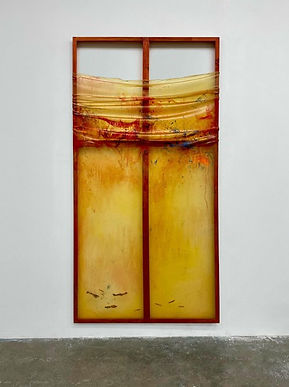
Lecturer Gavin Edmonds, who came to support our show, suggested experimenting with working without stretchers. This was an intriguing idea that has lingered in my mind. While my current work concerns windows, and hence, I work with frames and stretchers, I am excited to try different presentation formats if possible. Sam Gilliam and Katharina Grosse are some artists I have come across during my research who have successfully explored similar concepts, inspiring me to try this approach in future projects.
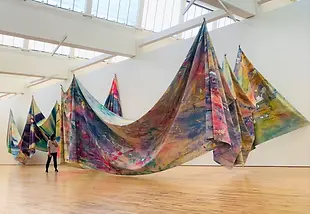
Sam Gilliam, Double Merge (1968) (Davis, 2019)

Katharina Grosse, The Horse Trotted Another Couple of Metres, Then it Stopped, 2017 (Carriageworks, 2018)
Carriageworks (2018). Katharina Grosse: The Horse Trotted Another Couple of Metres, Then it Stopped - Announcements - e-flux. [online] www.e-flux.com. Available at: https://www.e-flux.com/announcements/169017/katharina-grossethe-horse-trotted-another-couple-of-metres-then-it-stopped/.
Davis, B. (2019). How to Look at a Sam Gilliam Painting: With One Eye on History and the Other on Color and Form. [online] Artnet News. Available at: https://news.artnet.com/art-world/sam-gilliam-drape-painting-dia-1634428.
Duong, K. (n.d.). KV Duong. [online] KV Duong. Available at: https://www.kvduong.com.
iiii2 (2023). 小红书. [online] www.xiaohongshu.com. Available at: https://www.xiaohongshu.com/explore/64c8d1af000000000c03773c?app_platform=ios&app_version=8.30&share_from_user_hidden=true&type=video&author_share=1&xhsshare=CopyLink&shareRedId=N0tHRTg2OUw2NzUyOTgwNjY0OThHODo_&apptime=1716144707&exSource= [Accessed 21 May 2024].
Management (n.d.). Anastasia Komar ‒ Management. [online] management.nyc. Available at: https://management.nyc/artists/anastasia-komar/works [Accessed 22 May 2024].
Rasealy (2023). 小红书. [online] www.xiaohongshu.com. Available at: http://xhslink.com/DR3uHJ [Accessed 21 May 2024].
Thomas, E. (2022). Art and film collide in Yoora Lee’s cinematic oil paintings. [online] www.itsnicethat.com. Available at: https://www.itsnicethat.com/articles/yoora-lee-art-170322.
Xiao Xiang Tong Xie (2023). 小红书. [online] www.xiaohongshu.com. Available at: http://xhslink.com/7z9uHJ [Accessed 21 May 2024].