


*Click on the photographs for an in-depth explanation of each painting


Additional Content
MA Research Festival Proposal
Post-summer exhibition, Professor Geraint introduced me to films such as 'An Angel at My Table' and 'Godfather', and reminded me to challenge my pre-conceived notions about the colours of intimate memories. Building on my own initial research into colours of memory, I find that for me, rather than assigning a certain colour to memory, different colour combinations trigger different memories. For example when I see the colour combination of: baby pink, gentle green and blue, it reminds me of the Sakura sweets I ate in Japan. Hence, I have started making it a point to record meaningful colour combinations .Building on my research, I aim to create a colour diary.
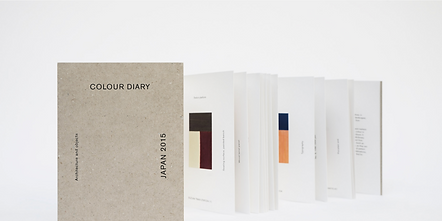
Sample: One way I might display my research into colour. Margrethe Odgaard, an acclaimed textile designer once said to "have simplicity as a clarified vision." (muuto, 2024). Borrowing from this idea, I plan to make the colour diary as simple as possible and to put all the focus on colour combinations.
It is true that nature has given us some of the most beautiful colour combinations. However, in this colour diary, I am interested in combinations of colour created by humans. This includes architecture, objects and food. I am interested in 'man-made' colour combination as these colour combinations are consciously made decisions, they represent emotions, tradition and cultural memory. In the words of Odgaard, "These colour schemes could be seen as evidence of choices, behind which there had to be traces of tradition and culture" (Odgaard, 2023).
Initial Plan

My initial plan was to create a book of ombre colour combinations. However, I eventually gave up on this idea and settled on creating colour palettes of three colours. This is a visual reference to music chords (elaborated below).
Example of ombre chart (Odgaard, 2020)
Current Plan

As elaborated under critical reflection, sensory elements help evoke intimate memories. Similar to how music is able to evoke feelings of intimacy, so too can colour combinations.
When we play a single note on a piano, it is nothing but a sound.However, when notes are combined, it becomes music. In the same way, combinations of colours are able to change perception emotionally, bringing out distant memories and feelings of intimacy (Odgaard, 2023).

Each colour combination will be created on-site to ensure the hue, saturation and brightness of colours are captured accurately
The colour diary presented during the research festival, takes inspiration from my trip to The Netherlands a month ago. I hope that when viewers flip through the book, it will help evoke memories of their own experiences.

Details : Digital printing on Silk Organza
Dimension: 40 cm x 105 cm

Compared to colours on regular paper, I find them more beautiful on silk
As mentioned under documentation, I experimented with making a colour atlas on silk during Unit 3. Hence, I am contemplating translating some of my colour combinations in the colour diary into silk books.
Residency Program @Espacio Gallery

Over the summer holidays, I participated in a one-week residency program at Espacio Gallery with four other exhibiting artists.
As I briefly covered under documentation, I exhibited existing works during the residency, including a panel from 'Beneath the Veil of Drooping Lashes'.
Gavin Edmonds dropped by during the residency, and we discussed the summer show. Gavin Edmonds mentioned that out of all my works, he felt I should further explore the potential of the acrylic panel with silk fibers from 'Beneath the Veil of Drooping Lashes'.


Utilizing the fact that the residency provided physical space for experimentation, he encouraged me to attempt placing the panel at different locations and observing how it interacts with varying environments.We placed it near the window, and we all felt that the silk fibers interacted with the sky beautifully.

It reminded me of Chang Kai Chun's paintings. In his works, "through the texture of light and chromatic fields, he creates spaces of contemplation where memories and emotions incarnate."(Galerie L'inlassable and Galerie L'inlassable, 2022). This parallels my practice and influenced me to contemplate bringing elements of the natural world into my work.
(Galerie L'inlassable and Galerie L'inlassable, 2022)
As acrylic sheets are not easy to paint on, I decided to experiment with printing on acrylic sheets. As it was my first time working with color on acrylic sheets, multiple failed pieces existed before I achieved my desire. Additionally, I am not skilled at Photoshop, which made printing on acrylic sheets even more challenging. I am very grateful the team at Genesis Imaging was patient. They used their expertise to help me achieve my desired outcome via Photoshop.
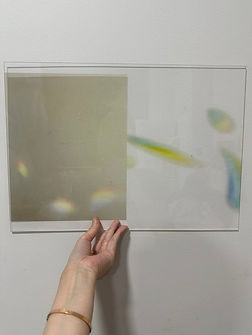


Experiment 1 and 2
Experiment 3
Experiment 4
My residency at Espacio Gallery was a unique experience. It was the first time I found myself surrounded by so many people who were able to provide me with new perspectives about my work at once- visitors, others in the residency program, and curators. Initially, I felt overwhelmed by the amount of information I received daily. However, Xuan, my classmate, who was also in the residency program, reminded me that I can draw on lessons I learned during my meditative yoga classes. Knowing that I wrote about the "blank/ negative spaces" and their significance in Asian art in Unit 2, we briefly discussed it and its relationship with the concept of 'qi' in Taoism (Seattle Japanese Garden, 2016). This conversation allowed me to see "blank/ negative spaces" from an ecological perspective, which was helpful in my later works, which feature elements of the natural world.
Studio Visit to Tessitura Luigi Bevilacqua

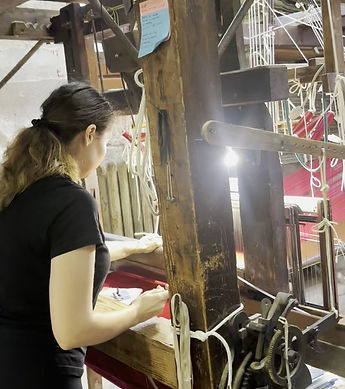


Over the Summer, I visited Tessitura Luigi Bevilacqua in Venice, Italy, and participated in their weaving workshop. Tessitura Luigi Bevilacqua dates back to 1499 (Tharawat Magazine, 2019).
Using unique weaving techniques on "original 18th-century looms, the family-run business continues to produce extravagant silk and velvet fabrics, the likes of which adorn the walls of ancient castles and aristocratic homes across Europe" (Tharawat Magazine, 2019).

Today, they supply fashion houses such as Dior with fabric.
I visited Venice this Summer mainly for the Biennale and to speak to the experts in weaving at Tessitura Luigi Bevilacqua. I wanted to have the opportunity to hear about weaving from these professionals as I struggled to use the loom (as seen in my work 'Beneath the Veil of Drooping Lashes', which I presented during the summer exhibition). I had many takeaways from this visit:
-
Techniques:
This was the main reason I traveled to Venice for the workshop. I learned so much, starting from properly setting up the loom to troubleshooting it when I encountered challenges. I was also introduced to equipment such as the table warp to make weaving less laborious.
-
Pacing myself:
I am not a very patient individual. The workshop taught me how to control my emotions, slow down, and appreciate the rhythm when weaving. Observing how meticulous the process is (some projects take years to complete) made me understand the importance of pacing myself. It also encouraged me to be more organized and focused when working with the loom.
-
Appreciation for Craftsmanship:
I was amazed at the amount of skill required to complete the fabric produced by professionals at Tessitura Luigi Bevilacqua. This deepened my respect for traditional craftsmanship. It also made me understand why some artists outsource certain aspects of their work. To achieve the level of expertise of the professionals at Tessitura Luigi Bevilacqua, one will have to spend countless hours perfecting their craft.
Kang Seung Lee @ Venice Biennale


Kang Seung Lee "engages the legacy of transnational queer histories, particularly as they intersect with art history" (Kang Seung Lee, 2021).
Over the Summer break, I had the chance to see Lee's works at the Venice Biennale. I was immediately captivated by how his installation looks like an aesthetic archive spanning time and space.I see parallels between Lee's work and mine in using materials to evoke memory and articulate time. Lee's art incorporates materials such as cow skin and sambe (a Korean textile associated with funerals) (Kang Seung Lee, 2021). These materials are imbued with historical and cultural significance, which allows Lee to transform them into "conduits for reflecting collective trauma" (AGA, 2024). In my practice, I use varying elements which have a significance to my culture (etc. silk, lace, and weaving). However, I often struggle with putting these elements together and presenting them together cohesively. This is shown in my 'Beneath the Veil' work presented during the Summer Show. Seeing how Lee gracefully integrates various materials was eye-opening for me.
I am also amazed at how Lee balances Eastern and Western cultural influences in his art. He respects his own culture via the incorporation of elements such as Sambe (traditional Korean textile). However, at the same time, he is able to respond to Western art history and contemporary issues. It is precisely this combination of elements athat allows hia art to act as a bridge, enabling his message to reach a wider audience. Hence, his work offers a model for how I might balance Eastern and Western cultural influences influences in my works. Such a balance is also what I look for as I hope to create work that is able to resonate with the broader audience, instead of being too personal.Hence, I aim to use cultural influences in my work more critically.
UAL professional toolkit talks:
Juliet Hayson + Alicia Paz


I found Juliet Hayson's and Alicia Paz's talk especially beneficial when considered as a whole.
Both talks provided advice on securing residencies. Hayson's talk focused on how to craft proposals, while Paz's talk focused on maximizing opportunities available. Both talks were very timely, as I am starting to look for residency opportunities. I used to think I needed many paintings to apply for residency opportunities. Hence, I have just started applying. This is because my practice significantly changed when I started this course, so I only have a few paintings that I can submit. However, Hayson's and Paz's talk reminded me that quality is better than quantity. Focusing on properly documenting existing works and crafting an effective proposal is more effective.
Additionally, I agree with Paz that "in the art industry, good opportunities are few and far between". This has especially been so in recent months when the economy is experiencing a downturn. Hence, I should not wait until I have enough work to submit. I should maximize any opportunities that are currently available. After all, there is no policy that I can only apply for the residency program once in my lifetime. If my application fails, I can try again in the subsequent year.
To add on, Hayson also reminded me that program auditors only need to understand what we can bring to their program. They do not need to see our entire portfolio. Hence, I can compensate for the lack of paintings by helping them visualize how my work will fit within their program. This can be done by using editing software to help auditors envision how my work can interact with their space. Hayson mentioned that this would significantly benefit my practice as I work with uncommon materials. Hence, program auditors might be hesitant about what I can bring to the program.
This also reminded me of a conversation I had with a gallery owner during Frieze London, who mentioned that when starting a gallery, it is essential to help potential buyers visualize how the artwork will look on a white wall to enhance the chances of sales. This is why most galleries these days (etc., Gagosian) work with Augmented Reality, mockups, and professional photography.
Ethics of using animal in art


I use silkworms to spin silk fibers over my canvas in my works. This involves using animals in art, which is a sensitive yet complicated topic.
By nature, when there is no human interference, moths would break out from their cocoons after transformation (Peta UK, 2015). However, this breaks the silk filament produced, causing about a kilometer of silk filamemt wastage (Peta UK, 2015). This also makes the silk filament unsuitable for weaving. Hence, in the silk industry, silkworms are either "steamed or boiled alive inside their cocoons" (Peta UK, 2015). In my opinion, this is highly unethical. In the research paper, 'The Animal Is Present: The Ethics of Animal Use in Contemporary Art', a key question is if "there is a good enough reason to subject these animals to any discomfort," as some might argue that art is "mere entertainment"(CROSS, 2018). I personally believe that the answer is that there is that there is no reason that can justify causing harm to another living organism just for art.
I was unaware that silkworms are either "steamed or boiled alive inside their cocoons" when I started using silkworms in my art. I became aware of this ethical issue after I visited a silkworm farm a few months ago (CROSS, 2018). With this in mind, I had a conversation with the silkworm farmer, and he suggested we can let silkworms naturally break out of their cocoon instead of steaming or boiling. This is a possible compromise because I do not need a 'continuous' silk thread in my work; I am able to work with fragmented silk fibers.
However, it is important to know that it can be argued that "using an animal without regard for that animal's interests is a form of disrespect", and that "this might be true even if the animals don't suffer at all" (CROSS, 2018). In my opinion, the way I use silkworms in my art does not fall under this ethical concern. This is because even without human interference, silkworms would be spinning silk.
Overall, artworks involving animals are capable of being ethical. As long as they respect "conventions of aesthetic engagement and appreciation in the context of the gallery" (CROSS, 2018).
Elise Peroi @ Hermes (Amsterdam)


Elise Peroi is one of my favourite artists.
Through her work "based on weaving and opening up spaces", she seeks to "convey an all-encompassing vision of the world, where everything around us is no longer a matter of 'seeing', but of living" (Irene Laub, 2024). She has participated in numerous exhibitions with institutions such as Fondation privée Carrefour des Arts and the Bally Foundation. In 2015, She was also awarded the Prix d'excellence by the City of Brussels (Irene Laub, 2024).
I first saw her works when she was exhibiting with Fondation Thalie in France. Then, I had yet to start experimenting with weaving, but I was amazed by her color palette and unique frames. Her work pushed me to consider how I can present my work. Not immediately influential as I browsed the works, but something lingered.
A few months ago, I started my exploration into weaving as a means to articulate time. Hence, I contacted her to get some advice regarding the technicalities of weaving. She invited me to view her installation, which is currently showing at the Hermes store in Amsterdam.I have elaborated under critical reflection on how Peroi introduced me to the concept of recurrence and its relationship with the articulation of time ( further elaborated under methods, material, and processes). However, Peroi's work at Hermes developed considerably from her past works. Peroi mentioned that one of Hermes's requirements was to incorporate their products into her work. I was amazed at her approach. Her work successfully integrated art with the environment. They were more interesting than mere visual presentations. This made me ponder how I can step out of traditional boundaries and create immersive experiences through my work.


Canadian Pavilion @ Venice Biennale (Macabasco, 2024)
This reminds me of "Trinket," Kapwani Kiwanga's exhibition at the Canadian Pavillion at this year's Venice Biennale (Macabasco, 2024). The Canadian Pavillion is one of the smallest pavilions in the Giardini. However, the artist creates an immersive environment by utilizing the unique walls of the pavilion and covering the interior and exterior with glass beads. Even Vogue has praised the work of Kiwanga, declaring that "such alluring aesthetic qualities are frankly rare on these grounds of late" (Macabasco, 2024). When it comes to my own work, I often feel restricted by external circumstances such as lighting. I do not have an answer to this yet. However, I am starting to think about how I can make my art incorporate the environment it is exhibiting in instead of always forcing the environment to accommodate my work.
Canadian Pavilion @ Venice Biennale (Macabasco, 2024)
Lastly, I am very grateful she is willing to share her knowledge with emerging artists like myself. Her advice has been invaluable. Beyond technical guidance, her generosity also inspired me to foster a similar spirit of collaboration and mentorship in my artistic journey.
Charlotte Edey @ Anat Egbi Gallery

Charlotte Edey , 2024 Anat Ebgi, Installation view (Anat Egbi, 2024)

Charlotte Edey , 2024 Anat Ebgi, Installation view (Anat Egbi, 2024)
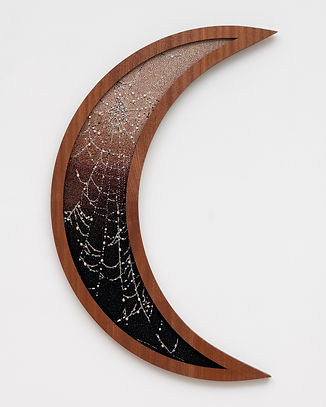
Charlotte EdeyWeaving, Waning, 2024 (Anat Egbi, 2024)

Charlotte EdeyWeaving, Waning, 2024 (Anat Egbi, 2024)

Charlotte EdeyPause, 2024 (Anat Egbi, 2024)
Charlotte Edey's exhibition at Anat Ebgi is one of my favorite exhibitions this year.
In Edey's work, the language of drawing is explored via mark-making and gesture "through extensive hand-embroidery and beading on tapestry" (Anat Egbi, 2024). Similar "to hatching and stippling, these processes forge direct relationships between line, thread, and surface" (Anat Egbi, 2024).
I am particularly impressed by Edey's use of symbolism. In her exhibition at Anat Ebgi, "wooden frames shaped like punctuation marks (commas, parenthesis, etc.) house the artist's abstract tapestries, pulling the viewer into the midst of her unique conversation." (Anat Egbi, 2024). I am also interested in using symbolism in my paintings (etc., iconic childhood candies in 'Wrinkled Time'). Her work taught me that symbolism is a powerful way of creating emotional landscapes. It has inspired me to think more deeply about how to use symbolic elements in my paintings to elevate the thematic depth of my work. Through this, I hope to invite viewers to pause longer to explore multiple layers of meaning in my work.
During Frieze London, I saw Edey's work again. Seeing her work in person made me realize how much detail goes into her work. For example," her jacquard weavings are hand embellished with thousands of glass seed beads and freshwater pearls" (Anat Egbi, 2024).

The Tower, 2024 (Show Studio, 2024)

The Tower, 2024 (Show Studio, 2024)

Loose Knit, 2024 (Show Studio, 2024)


Loose Knit, 2024 (Show Studio, 2024)
During Frieze London, I saw Edey's work again. Seeing her work in person made me realize how much detail goes into her work. For example," her jacquard weavings are hand embellished with thousands of glass seed beads and freshwater pearls" (Anat Egbi, 2024). She also uses organic materials such as "crystal, moonstone, opalite, obsidian, onyx, lava, and topaz" (Anat Egbi, 2024). Her use of materials impressed me. I have always been interested in using materials to enhance the thematic depth of my work, especially organic materials such as silk and pearls.

In recent months, I have explored jewelry design via courses at Sotheby's. I became interested in the symbolism and beauty of natural materials such as pearls and sapphires.
Hence, I am thinking about how to incorporate this into my paintings. Seeing Edey's work in person at Frieze London gave me fresh ideas on integrating these elements into my art. This helped to lay the foundation for my painting ' Lilacs Baptised in Blueberry Butter'.


Earring which I designed
Material: Jade and Diamond
Ring which I designed

Rring which I designed
Millbank Residency


The school organized a residency program (Millbank Residency), which started right after my residency program at the Espacio Gallery. Since I was free during the summer, I decided to participate in the program.
During this residency, we were provided a table and offered the possibility of booking empty rooms. However, during the summer, I was working on mastering how to use the loom. It was not possible to bring the loom into the residency space. Hence, I mostly worked from home.
Even though I mostly worked from home, I had valuable takeaways from various student-led group presentations (Every week, a student will propose a topic of discussion and lead a presentation surrounding the subject).


Steph Huang @ Tate Britain
As the residency program was beside Tate Britain, we occasionally organized trips to the museum and exchanged thoughts about the art pieces on display.
Future Plans
UOB Painting of the Year 2025
Cuturi Gallery Residency


The UOB Painting of the Year is launched in 1982. As the longest-running art competition in Singapore and one of the most recognised in Southeast Asia, it has provided a platform for many emerging artists.
=>Post-graduation, I need a platform to get back into the art industry in Singapore. This competition which has nurtured many emerging artists will be a good starting point for me
=> The UOB Painting of the Year award has nurtured artists such as Vanessa Liem, who also happens to be a student from BA Painting at Camberwell College of the Arts. Liem has gone on to develop her career internationally, after winning UOB Painting of the Year.
Cuturi Gallery 's residency program is one of the stronger residency programs in Singapore. Cuturi Gallery provides a very comprehensive experience for participants of the program.
=>Post-residency, they provide exhibition opportunities, as well as the chance to take part in art fairs such as Taipei Dangdai and ArtSG
PhD
I am also considering furthering my studies in the arts and getting a PhD. One reason is because my bachelors degree is in Ecnomics. Hence, I am considering getting a PhD to gain more art-related academic experience.
Another reason is that a PhD will allow me to delve deeper into my research interests by providing the opportunity to engage with leading scholars, and participate in critical discourse.
AGA (2024). Kang Seung Lee. [online] Alexander Gray Associates. Available at: https://www.alexandergray.com/artists/75-kang-seung-lee/ [Accessed 20 Nov. 2024].
Anat Egbi (2024). Charlotte Edey: All Words Are Written In Water - ANAT EBGI GALLERY. [online] ANAT EBGI GALLERY. Available at: https://anatebgi.com/exhibitions/charlotte-edey-all-words-are-written-in-water/ [Accessed 20 Nov. 2024].
colorone (2022). Iro (色): one word, many colors. - Color One. [online] Color One. Available at: https://www.colorone.blog/iro- [Accessed 20 Nov. 2024].
CROSS, A. (2018). The Animal Is Present: The Ethics of Animal Use in Contemporary Art. The Journal of Aesthetics and Art Criticism, 76(4), pp.519–528. doi:https://doi.org/10.1111/jaac.12587.
Gail, T. and Zhou, J. (2021). Language Of Color In China. S.L.: Cambridge Scholars Publis.
Galerie L'inlassable and Galerie L'inlassable (2022). Kai-Chun Chang - Galerie L’inlassable. [online] Galerie John Ferrère. Available at: https://galeriejohnferrere.com/kai-chun-chang/ [Accessed 20 Nov. 2024].
Irene Laub (2024). ÉLISE PEROI - Irene Laub. [online] Irene Laub. Available at: https://irenelaubgallery.com/artistes/elise-peroi/.
Kang Seung Lee (2021). About. [online] Kanglee.net. Available at: https://kanglee.net/page/3-About%20.html.
Macabasco, L.W. (2024). With Millions of Glass Beads, the Canadian Pavilion at the Venice Biennale Creates the Monumental Out of the Minute. [online] Vogue. Available at: https://www.vogue.com/article/canadian-pavilion-venice-biennale-kapwani-kiwanga-gaetane-verna [Accessed 20 Nov. 2024].
muuto (2024). Around Coffee Table | Create a unique and refined setting. [online] Muuto.com. doi:https://doi.org/100000000/apple-icon-57x57.
Odgaard, M. (2020). Margrethe Odgaard on Instagram: ‘Sketches in morning light #margretheodgaard’. [online] Instagram. Available at: https://www.instagram.com/p/CTMN779MZbA/?igsh=MTExNDNiczlmY3g3OA%3D%3D [Accessed 20 Nov. 2024].
Odgaard, M. (2023). [online] Margretheodgaard.com. Available at: https://margretheodgaard.com/archive/ [Accessed 20 Nov. 2024].
Peta UK (2015). The Silk Industry | Animals Are Not Ours to Wear | PETA UK. [online] PETA UK. Available at: https://www.peta.org.uk/issues/animals-not-wear/silk/.
Seattle Japanese Garden (2016). Yohaku no bi: The Beauty of Empty Space. [online] Seattle Japanese Garden. Available at: https://www.seattlejapanesegarden.org/blog/2016/03/15/yohaku-no-bi-the-beauty-of-empty-space.
Show Studio (2024). Frieze Highlights: Enter Charlotte Edey’s Magical Realm | SHOWstudio. [online] Showstudio.com. Available at: https://www.showstudio.com/news/frieze-highlights-enter-charlotte-edeys-magical-realm [Accessed 20 Nov. 2024].
Tharawat Magazine (2019). Tessitura Luigi Bevilacqua: Traditional Fabric Weaving in the Heart of Venice since 1875. [online] Tharawat Magazine. Available at: https://www.tharawat-magazine.com/craftsmanship-42/special-features-42/bevilacqua-traditional-italian-fabric-venice/ [Accessed 20 Nov. 2024].