


*Click on the photographs for an in-depth explanation of each painting


Written in Water
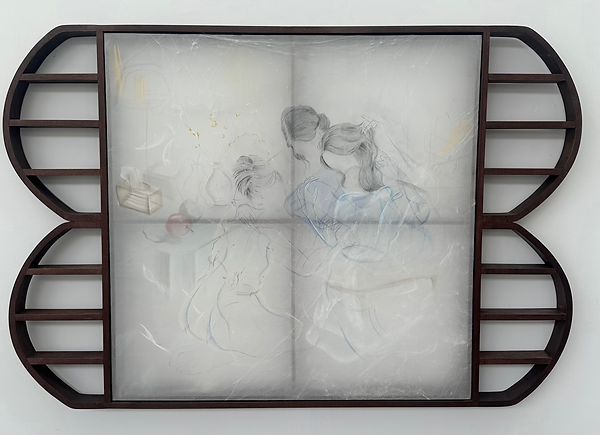
Title: Written in Water
Material: Earth and mineral pigment, chalk, color pencil, conte, and shellac, on silk.
Size: 124 cm x 84 cm
Year: 2024
_heic.png)
My practice shifted after the Easter break to focus on capturing fleeting moments of intimacy while articulating the temporality of the passage of time. In harmony with the ebb and flow of time, I also explore concepts related to disappearance and transformation within the fabric of intimate memories.It was also after the Easter holidays, I had a breakthrough in my understanding of materiality.
Under 'methods, processes and materials' in Unit 2 , I explained why there was a shift in my research direction, as well as why I am interested in intimate moments.In Unit 3, beyond purely capturing intimate moments, my practice developed to explore 'intimate symbiotic relationship between humans and their surroundings while articulating the temporality of the passage of time'. I will further elaborate on this in my critical reflection (Unit 3).
Unit 2's methods, processes and materials elaborates on how I use materiality to articulate the passage of time. Following from Unit 2, I had new understanding of the use of Silk as a material in my work , specifically its relationship with the articulation of time through the 'rhythms of the natural world' which I will elaborate under critical reflection (Unit 3).
The first batch of painting after this development in my practice was created for the Copeland Gallery show (Unit 2). This set of work created for the Summer Show was the second time I attempted this method of created paintings. A summary of the process of creating this painting (will be further elaborated in other sections):
memory drawing (without prompt) -> memory drawing (with prompt)-> place silkworms on the canvas to spin silk
As with past works, I started this painting by delving into my memories. While post-Easter, I want to expand my practice beyond understanding the process of memory formation, memory drawing remains an essential aspect of my practice. As I recall details of particular moments, memory drawing allows me to 'stop time' and re-immerse myself in the intimate essence of those experiences.
For the MA Summer Show, I presented three works.
Differing from Unit 2, my works in Unit 3 moves away from capturing intimacy in a domestic space to explore 'intimate symbiotic relationship between humans and their surroundings. I wanted to challenge myself to explore intimacy outside my home. I will further elaborate on this under critical reflection.
The first work is ‘Written in Water’.
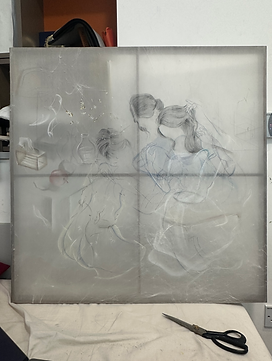
This painting was inspired by my visit to Iga City in Japan for a family wedding. During the trip, we happened to drop by Minomushian, one of Japan’s famous writing retreats. There, I had the opportunity to learn more about the fascinating nature of Haiku."Haiku is a distinctive style of Japanese poetry" that is known for its simple structure and the beautiful imagery it can evoke (Mie Prefecture Tourism Federation, 2024). It was there that I came across Chiyo-ni’s (one of Japan’s most famous female haiku poets) Haiku on Motherhood.
The morning glory
Has captured my well bucket.
I beg for water.
-Chiyo-ni (All Poetry, 2024)
In this haiku, the morning glory wrapping around the well bucket symbolizes the pull of motherhood and family responsibilities. This paints an image of how Chiyo-ni's life is inseperable with her children’s needs.It reminded me of the wedding in Iga City that I had just attended. I remember watching as the bride was embraced by her mother, grandmother, and sister at various touching moments. At times, their embrace consisting of four generations formed a circle. Just as the morning glory quietly, yet resiliently wraps itself around the bucket, each female family member around the bride embraces her with a touch full of their own wisdom, and hopes for her.
Other moments I vividly remember from the wedding was when the bride's mother joined her daughter in a loving gesture reminiscent of the traditional kamisuki no gi, the ceremonial hair-combing. As the bride's family was taking a more modern approach to the wedding, it was replaced with the lowering of the wedding veil.
Perhaps because I am turning 25 this year and reaching the age where people around me are getting married, the wedding in Japan is one of the many weddings I have attended this year. Even though I have been to so many weddings, I still enjoy attending the weddings of those who are important to me. I get to witness many touching moments and form intimate memories with those who matter to me.
<<< The DV tape supporting work is included below under the supporting work section>>
***Please click below to play the video***
Details:
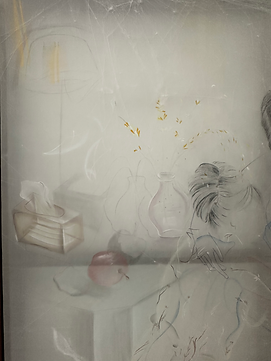
Double-vision effect
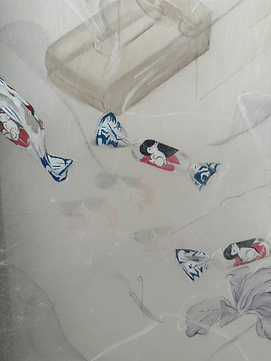
This detailed shot is from 'Wrinkled Time': Varying paint densities-'permanent and solid' vs 'movements and changes'
In Unit 2’s feedback, I was introduced to artists Hiroshi Sugimoto and Michael Wesley, whose approaches to capturing time and movement sparked inspiration for my own work. I will elaborate more about their influence on my art under critical reflection. However, in summary, Sugimoto’s photographs, inspired me to experiment with double vision effect through multiple lines in my paintings.Meanwhile, Wesley's work inspired me to experiment with paint density to mimic the compression of time into a single frame.
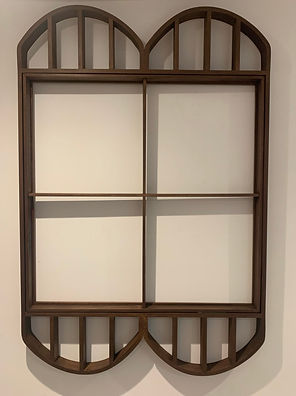
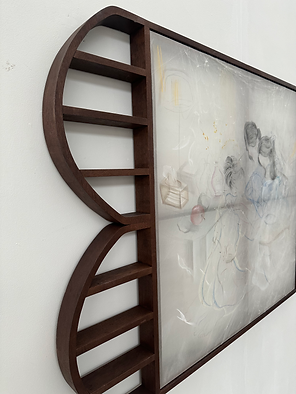
During my visit to Japan, I was told Windology is a significant aspect of Asian architecture. Influenced by Japanese windology, for this piece, I wanted to further explore the idea of sculptural-paintings. Windows in this context function as "curated frames, selecting and shaping the external view for those within", as in the Bosen tea room in Asian households, where the tea master selects a particular view for his guests, creating a shared yet intimate experience of the landscape (Larsen, 2019).
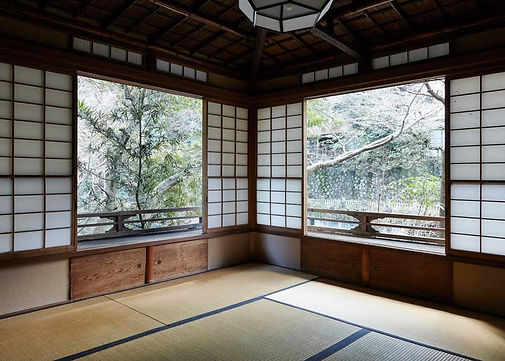
Example of windows in Japan (Larsen, 2019)
This idea of controlled framing, where only a part of the scene is revealed, resonates deeply with my art practice, which focuses on articulating messages about time and exploring intimacy.In Japanese literature, one author described this quality as ‘a Japanese room might be likened to an inkwash painting, the paper-paneled shoji being the expanses where the ink is the thinnest, and the alcove where it is the darkest.” (Bradshaw Foundation, 2022). This analogy reflects my approach to capturing time and intimacy in my art, where layered textures and sculptural depth act as boundaries, framing certain elements while concealing others.
I continue to apply several techniques from Unit 2.
This includes overlapping lines to convey emotions and hence intimacy (elaborated under unit 2 ) .
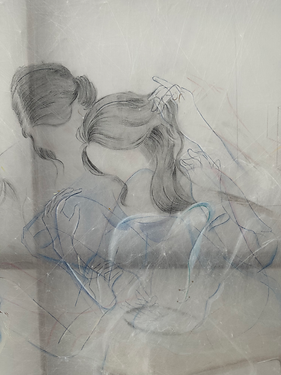
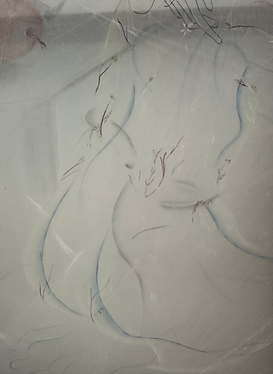
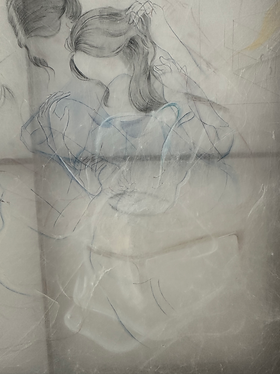
A brief summary of techniques used in Unit 2 which I continue in Unit 3 :
In Unit 2, during a group critique with Gavin Edmond, we discussed abstract expressionism in the context of my classmate Alberto's works. A topic that was brought up was the power of line and gesture in conveying emotion. I found overlapping lines an intriguing concept that I could adapt to my practice. I realized that messing up the lines would make the canvas less restrained, which was aligned with the notion of intimacy, the ephemeral, and time.
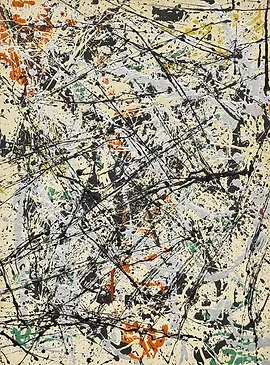
Much like the works of Jackson Pollock, whose drip paintings blur the boundaries between chaos and control (MoMA, n.d.).
Jackson Pollock's Number 32, 1949 (MoMA, n.d.)
All these culminate in the further layering of lines as life silkworms spin silk on my canvas.
Playing with the 'blank space' (elaborated under Unit 2) also remains a key part of my practice. This includes notions such as the 'tug-of-war' between absence and presence on my canvas, as well as creating a sense of ambiguity. By letting go of some control of the canvas, I give blank spaces to tell their own narratives. All these are tied to how I convey a sense of intimacy while articulating time.
The final step in my work is guiding silkworms to spin silk fibres on my canvas. Through this, I hope to create sculptural-paintings of time and intimate memories. I have explained this in Unit 2.
As explained under 'methods, processes and materials' in Unit 2, silk is closely linked to my interest in intimacy, memory, time, the ephemeral and fragility of human experiences. I have also summarised under critical reflection (Unit 3) how the process of silk production is linked to the articulation of time through both its materiality, as well as its relation to the rhythms of the natural world.
In Unit 2, I began experimenting with the materiality of silk. As I was still unfamiliar with the material and uncertain about the outcome, I completed all stages personally.In Unit 3, I felt more certain about the outcome and the materiality of silk, hence I decided to outsource the stage of guiding silkworms to spin silk on my canvas. Amongst many reasons, the most prominent would be that when silkworms spin silk, they produce animal waste (simply put, faeces). Unlike silk fibers, animal waste are not able to withstand the march of time.Professional silkworm farmers are able to guide silkworms to leave minimal waste, and filter out these wastes. Another reason I chose to outsource the spinning of silk fibers is to allow myself to focus more on fully developing the imagery on the canvas.
Supporting work:
I am grateful to everyone who shared their wedding footage with me. I have carefully selected those that align with my work.
***please click to play***
In context of other works in the show
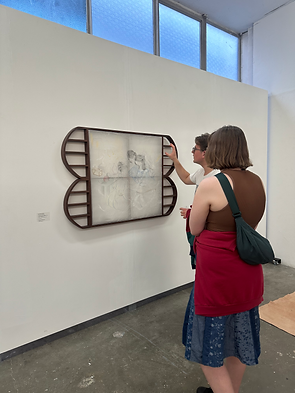
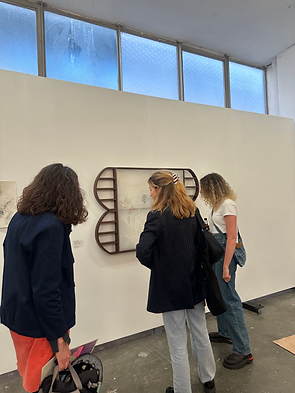
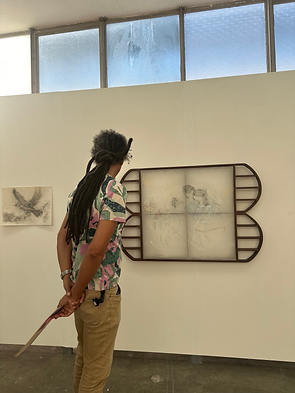
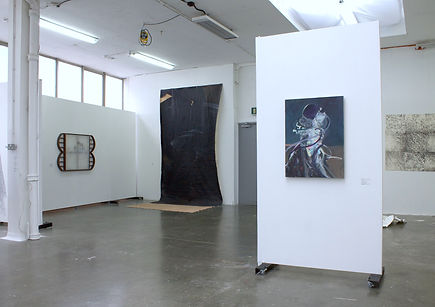
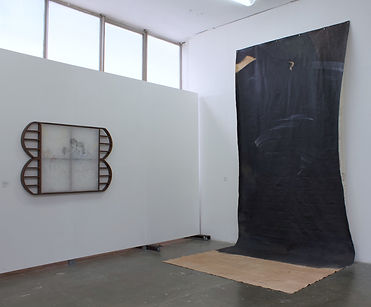
Challenge : I struggled a lot with lighting in the Summer exhibition. Silk is a material that relies heavily on lighting due to its transparency.
There were various hiccups along the way but, it was kind of my classmate, Ernesto, to agree to move his some of his paintings so that my works can be exposed to natural sunlight.
I am very grateful that Ernesto is able to make this compromise. It turned out well eventually, and quite a number of people mentioned that it was interesting that such a 'light work' (my work) was placed beside a 'darker work' (Ernesto's work).
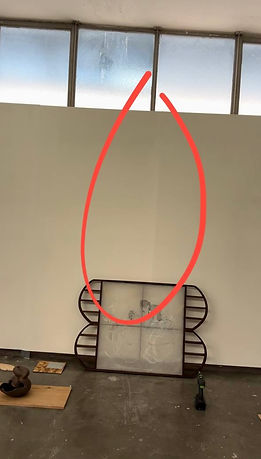
To add on, this "wall' was not flat. Hence we had trouble hanging it onto the wall.
Thankfully, with the help of the technical team, we eventually managed to shift the partitions and straighten the "wall".
Experimentation
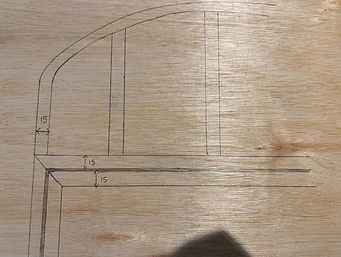
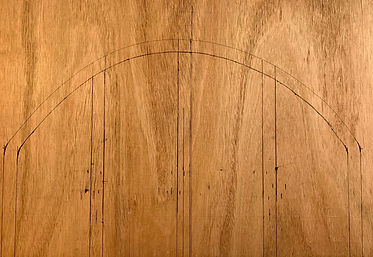
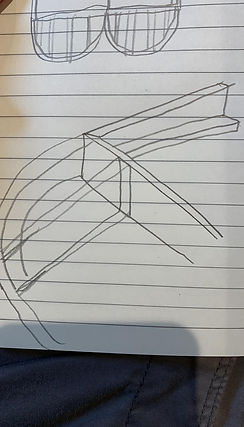
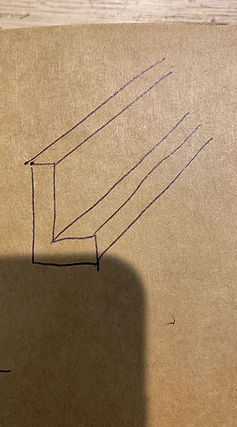
1. Experimentation with framing format
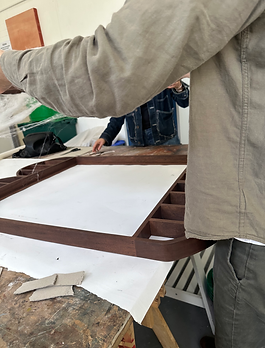
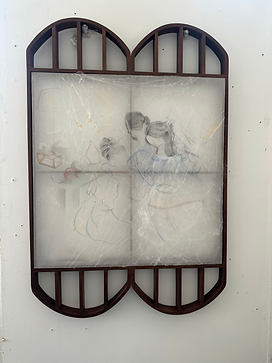
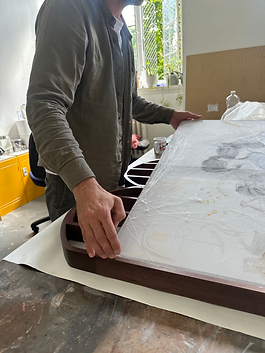
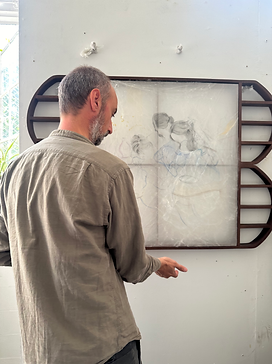
Experimented with 'horizontal vs vertical' placement of the frame
2. Experimentation with various framing styles
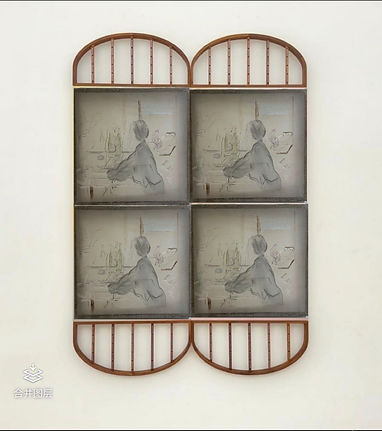
Initially considered collage format. Gave up on this idea as I did a mock-up and I felt it is too messy aesthetically
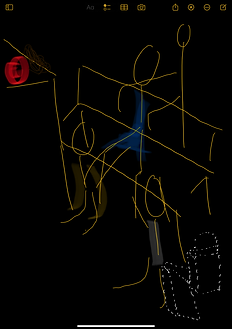
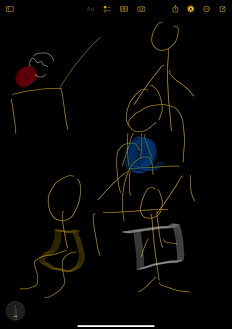
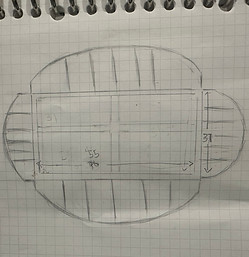
3. Experimenting with sketches:
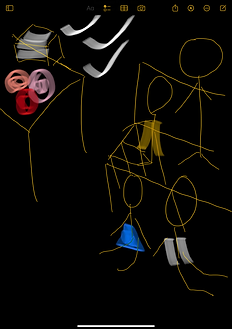
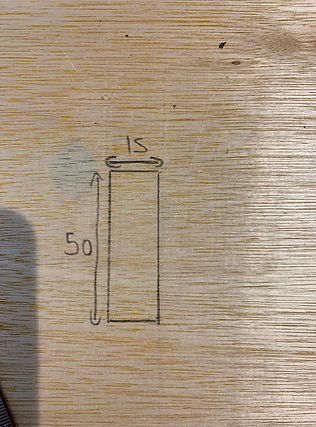
4. Experimenting dimensions of the frame:
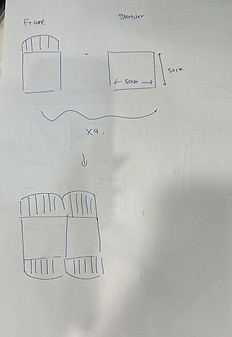
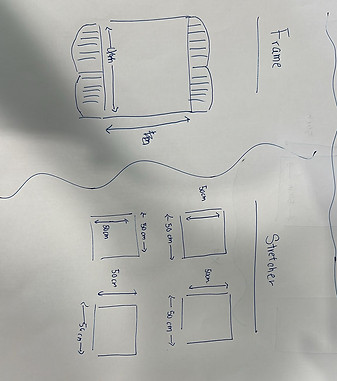
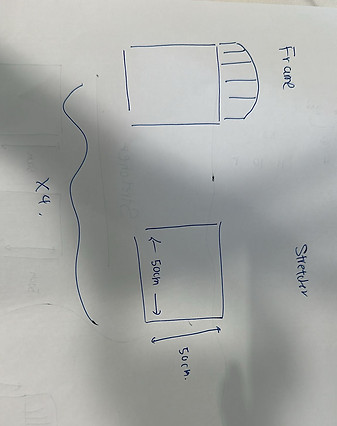
Feedback
The Summer Show provided a valuable opportunity to gather feedback on my work. It showed me possibilities of new directions on how I can refine my approach to my practice.Based on the responses I received, I have began to consider:
-
Experimenting with the Idea of Containment:
Branching from my exploration of frames, one feedback I received was the possibility of exploring the idea of "containment" within my canvas and the frames. This gave me a few ideas:Most obvious would be the concept of how memories are stored or “contained”. This suggests that by introducing boundaries or in the case of my works, frames, I might more effectively capture intimate memories..
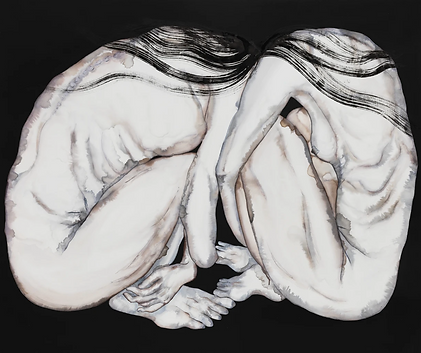
However, this feedback also reminded me of Zhang Ming Xuan’s paintings I saw at Art Basel Hong Kong a few months back which featured bodies being “contained” in limited spaces. If there is an opportunity in the future, I would possibly explore the concept of “contained” bodies or items on my canvases.
Whisper, 2024 (Hive Contemporary, n.d.)
-
An Angel at My Table (Colors in Relation to Memory):
During the feedback, I was also reminded of the psychological aspect of art and how color plays a role in the emotional value of memory. This especially applies to distant memories (etc childhood memories). One movie that was recommended to me was An Angel at My Table. An Angel at My Table uses color to portray how emotionally significant of Janet Frame’s memories are. A range of color palettes is used my the director to distinguish between the innocence of childhood, and the challenges of adulthood (McNeill, 2015).
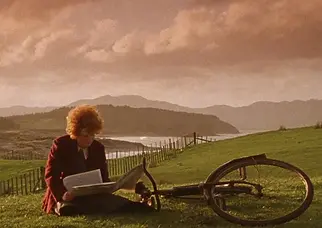
For example, warm, saturated colors are used in the scenes of Janet’s childhood. This includes scenes such as (McNeill, 2015):
-Young Janet runs through lush fields
-Playing with her siblings
Such colours often bring out feelings of nostalgia and innocence of childhood. This suggest how childhood is often remembered as vivid and idealized.
Screenshot from 'An Angel at My Table' (McNeill, 2015)
-
The Godfather CPI Film Influence:
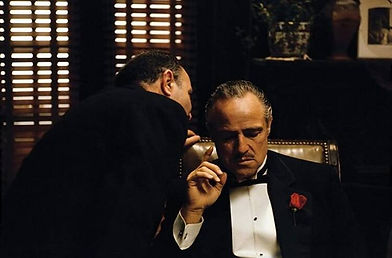
Another movie I was recommended was The Godfather, which is known for its classic, sepia-toned aesthetic.
=> Offers another way of showing how memories are often represented.
-
Addressing Assumptions on How We Aestheticize Memories:
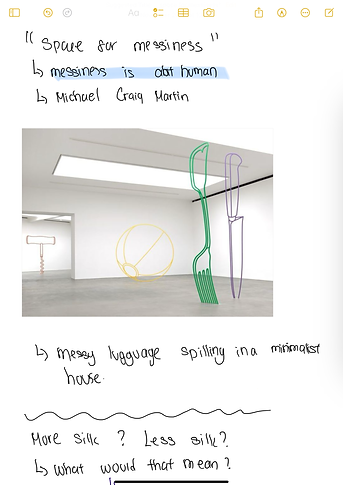
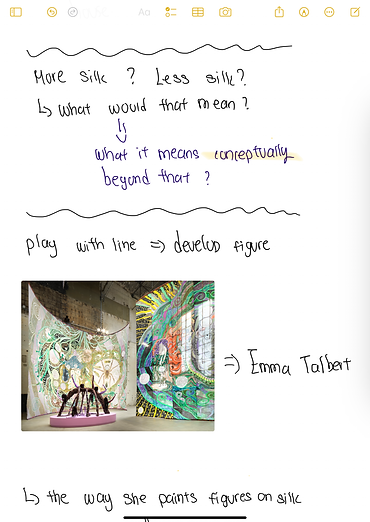
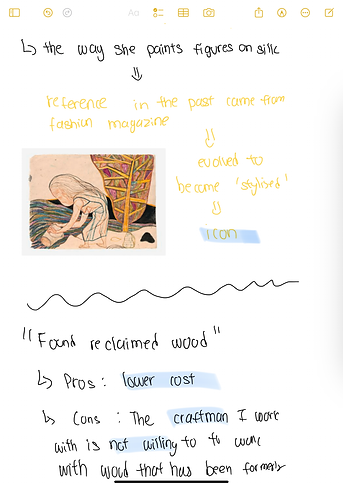
I had an interesting conversation with Professor Geraint regarding the colors of memories post summer exhibition.I personally have always felt that time and memories have an ephemeral quality to them. Hence, I have always chosen to use lighter and more ‘ephemeral’ colors. However, I was reminded that the relationship between colors and memories is very subjective.The above mentioned films also pushed me to question my assumptions about the way I aestheticise memory.
All Poetry (2024). The Morning-Glory by Maria White Lowell. [online] Allpoetry.com. Available at: https://allpoetry.com/The-Morning-Glory [Accessed 20 Nov. 2024].
Bradshaw Foundation (2022). In Praise of Shadows. [online] Bradshawfoundation.com. Available at: https://www.bradshawfoundation.com/news/rock_art.php?id=In-Praise-of-Shadows [Accessed 20 Nov. 2024].
Hive Contemporary (n.d.). Zhang Ming Xuan. [online] Available at: https://hiveart.cn/artists/zhang-mingxuan/ [Accessed 20 Nov. 2024].
Larsen, B. (2019). What are Shoji? Complete Guide to Japanese Paper Screens. [online] Japan Objects. Available at: https://japanobjects.com/features/shoji.
McNeill, I. (2015). An Angel at My Table (Jane Campion, 1990) – Senses of Cinema. [online] Senses of Cinema. Available at: https://www.sensesofcinema.com/2017/cteq/an-angel-at-my-table/.
Mie Prefecture Tourism Federation (2024). Take an enlightening journey into the history of haiku in Iga City. - Visit Mie in Japan, Once in Your Lifetime. [online] Visit Mie in Japan, Once in Your Lifetime. Available at: https://visitmie-japan.travel/en/report/detail_164.html [Accessed 20 Nov. 2024].