


*Click on the photographs for an in-depth explanation of each painting


Method, processes and materials
Why a change in my research direction?
Returning to Singapore over Easter after a brief stint in London, I found myself grappling with the changes in the landscape in my absence. These transformations stirred an array of memories while prompting a reevaluation of my understanding of time within the context of memory. Singapore, amidst its rapid gentrification and defined by its mono-climatic environment, offers a unique temporal experience. The perception of time in Singapore seems to oscillate between moments of standstill and perpetual repetition. The city-state's limited land space often leads to the demolition of historical buildings to pave the way for modern developments, perpetuating a cycle of change and construction that shapes its temporal landscape.This stood in stark contrast to England where centuries-old buildings are commonly seen.Ironically, these conditions have emphasized the consistency of impermanence in my outlook: moments as an accumulation of the gravity of time. In this context, time acts as a gravitational force, exerting pressure on our experiences and memories, shaping them (OpenAI ChatGPT, 2024).
From the perspective of memory, this concept highlights how our recollections are not static but are instead imbued with the weight of accumulated time. Each intimate memory carries within it the echoes of past moments, layered with the richness of our experiences and emotions. As time progresses, these intimate memories may evolve and shift, influenced by the changing contexts and perspectives that accompany the passage of time.
Memories
How I select memories:
The memories I work with are everyday memories and personal encounters. I have pondered extensively on how to select which memories to work with, or if I should even have a system for it. After much consideration, I have come to realize that I am simply a deeply emotional person. Emotional peaks in my life tend to coincide with the most intimate moments. When I reflect on my personal experiences, it is these intimate moments that naturally rise to the surface. To me, the most intimate moments are often imbued with human fragility. They are fleeting and ephemeral, yet profoundly impactful, encapsulating the raw essence of human existence.
In recent months, I have picked up meditative yoga, which has helped me uncover repressed memories ( as elaborated under critical reflection). Hence, now when I contemplate how to select the memories I work with, I simply listen to my heart during my yoga sessions and see which memory surfaces. I pinpoint the particular emotional highpoint in my life and reflect on the most intimate people, spaces, and things surrounding me at that moment. These intimate elements serve as anchors, guiding me to the core of the memory and infusing my artistic expression with genuine emotion and depth. By allowing my heart to lead the way, I tap into the authenticity of these experiences.
Memory drawing:
In Unit 1, I I provided an in-depth explanation of my approach to memory drawing. Hence, I won't elaborate on it extensively here. The main difference is that in this unit I not only rely on non-pictorial prompts, I also rely on pictorial prompts. Over the past few months, I have also gained new insights into the process.
1. Incorporation of mindfulness techniques to my practice has been useful.By cultivating intimate present-moment awareness and establishing a deeper connection with my environment, I have found that my memory drawings have become more nuanced and evocative.
2. I have experimented with various strategies to enhance the accuracy and vividness of my memory drawings.Regular practice and the use of mnemonic devices were amongst some techniques I tried. Amongst all, old-fashion practice is still the most effective in sharpening my observational skills and strengthening my ability to capture intricate details from memory.
Why intimate memories
I am particularly interested in the notion of intimate memories as it reflects the dynamic and ever-changing nature of human connections. As discussed under critical reflection, intimacy is not static; it transforms, disappears and appears. By exploring the motion of intimacy, I can track the contours of these personal connections. This gives me a medium to capture the fluidity and complexity of human experience.
Silk (external research)
Why I chose to do external research into the materiality of Silk:
Silk allows me to rip the spinal cord of numbers from my understanding of time in my research:
"One of the things that has always bothered me about the processing of time is how it boils down to numbers—cold, linear, sterile data points. I’ve always thought that this is antithetical to the true nature of time, which is emotional and elastic" (Ng, n.d.).
-Dawn Ng
In my opinion, time can speed up and slow down according to our mood. Time even seems to stand still when we are in love. Hence, in unit two, as I conscientiously searched for mediums which would allow me to express this. I thought to myself can I give color, shape and form? What color is 5pm vs 8pm? What structural mass does time have. This led me to explore ephemeral objects, and I found my answer in silk.
In Unit 1, I delved into the significance of silk as a fabric, intrigued by its texture and cultural importance.
However, it was during Unit 2 that I chanced upon the intricate production process of silk, a discovery that sparked a profound resonance within me about the fragility of human experience, time, memory, and the ephemeral. The cyclical journey of silk production—from the diligent labor of silkworms to the meticulous craftsmanship involved—captivated my imagination. It was during this time that I began collaborating with a silk farmer for external research.
In the production of silk, the silkworm takes center stage, a tragic hero in the grand theater of life, its existence intricately woven with the threads of time and destiny. From the humble beginnings of its birth to the wistful end, every moment is dedicated to the art of silk weaving, each thread spun with the silent requiem of passing time (Meng, Zhu and Chen, 2017). Yet, amidst its laborious toil, there lies a melancholic truth: after laying eggs, its final bow on life's stage, it succumbs to fate's gentle embrace. For the males, death arrives even more swiftly, a fleeting moment in the eternal dance of existence. Thus, in its poignant sacrifice, the silkworm embodies the bittersweet melody of time, memory, and the ephemeral (Meng, Zhu and Chen, 2017). This profound cycle of life and death allows me to use silk as a creation medium to capture the fragility of human experience while exploring the cyclical nature of time, memory, and ephemera. If you think about it, the moment you are born, you begin to die. The process of silk production yields to this law of nature, revealing the inherent beauty in death that overlaps with the cyclicality of time—a constant reminder of life's perpetual disappearance and transformation (OpenAI ChatGPT, 2024).
Also, in the culmination of a silkworm's existence, all that remains are delicate threads of silk, a testament to its singular purpose and transient journey. In a parallel reflection, humans too leave behind traces as we navigate the intricate tapestry of life. Much like the fragile strands of silk, our footprints upon the earth are ephemeral imprints, echoing the passage of time, the unreliability of memory and the fragility of human experience. As we traverse the vast expanse of existence, we weave our own narrative with each fleeting moment, leaving behind a mosaic of memories and impressions to form the fabric of life. This shared journey underscores the fragile essence of human existence, encompassing the emotional, psychological, and physical realms of life. Moreover, this reflection on the cyclical nature of life is further emphasized by the silkworm's journey. Before the silkworm dies, it lays eggs, initiating a new cycle of life and regeneration (Meng, Zhu and Chen, 2017). This cyclical pattern mirrors the broader cycles of existence, where life and death intertwine in an eternal dance of renewal. Hence, the various forms of silk (elaborated below) becomes a medium for me to articulate time, or the passage of time.
I also see similarities between the process of capturing intimate moments in life , and the process of cocooning. Just as the silkworm undergoes metamorphosis within its cocoon, these moments of introspection and self-discovery serve as catalysts for personal growth and transformation. In these sacred spaces of reflection, we confront our deepest fears, and emerge reborn, much like the silkworm emerging from its cocoon as a moth.
One afternoon, I found myself in an enlightening conversation with the silkworm farmer I had been working with. We had been discussing the intricacies of silk production, and I marveled at the dedication with which the silkworms labored to create such delicate threads. "You know," he said thoughtfully, "silk production is not just about numbers and measurements. It holds within it the wisdom of ages, the essence of life itself." Intrigued, I leaned in closer, eager to hear more. The farmer began to share his insights, drawing parallels between silk production and the timeless philosophies of Taoism, and Buddhism. As he spoke, I felt a profound sense of connection to these ancient teachings, despite not being particularly religious.
In Taoism, he explained, silk production mirrors the natural order, echoing Lao Tzu's wisdom that "Nature does not hurry, yet everything is accomplished." Here, time flows in harmony with nature's rhythms, much like the gradual yet purposeful creation of silk by the silkworm. Taoist principles of wu wei, or "effortless action," further underscored the instinctual spinning of cocoons, aligning with the natural cyclical flow of life or time. The idea that silkworms dedicate their entire lives to silk production, which is a cyclical process, can be a powerful metaphor for exploring the themes of time, memory, the ephemeral, and the fragility of human experience.The cyclical pattern he described underscored the impermanence of existence, inviting self-reflection on the fleeting nature of life's moments. "However," he continued, "in the 30 years that I have been raising silkworms, I have gradually come to understand their existence and the existence of the one who exists. I say that a single silkworm thread represents the existence and the silkworm the one who exists," he murmured, his words carrying the weight of decades of contemplation. "Just as when a person comes into this world, they leave behind a trace like a silkworm's's silk."
Similarly, Buddhist philosophy underscores the impermanent nature of silk production, echoing the concept of anicca, or impermanence. The Buddha's teachings affirm that "All conditioned things are impermanent," reflecting the fleeting yet essential aspects of the silkworm's life and the creation of silk (BBC, n.d.). Together, these philosophical perspectives illuminate silk production as a profound metaphor for the fragility of human experience and the passage of time. Through the intricate process of silk production, we are confronted with the interconnectedness of all things and the transient nature of existence. Silk becomes more than a material commodity; it becomes a symbol of life's impermanence and the enduring legacy of human memory. Thus, the exploration of silk production rip the spinal cord of numbers from my understanding of time, allowing me to contemplate the timeless mysteries of the universe.
*** my Chinese is not exactly what I would call good. The above conversation is translated from Chinese to English with the help of ChatGPT (OpenAI ChatGPT, 2024). My own input is sprinkled in between.
How I employ my external research into my practice:
All these culminate in my practice of using silk not only as a canvas but also encasing my entire canvas in silk fibres and silk threads (elaborated below & under here ) . In my opinion, the layers of silk within suggest transience and a fleeting life. It also functions as a non-numerical clock, articulating the passage of time. Objects wrapped by the silk are the sculpture of time, life and nature ( concepts of transformation and disappearance). This duality between transience and eternity is embodied in the silkworm itself. To better explain my idea, maybe I can first delve into my recent learnings about silk from a technical perspective.
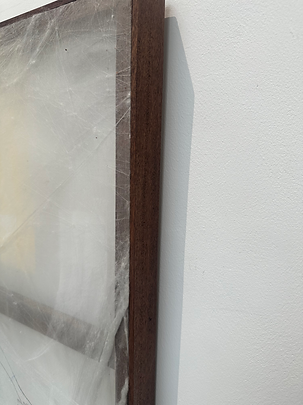
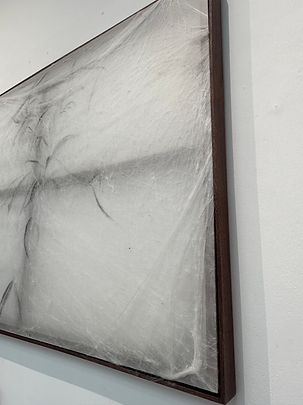
The life cycle of silkworm:
Video created with the help of 'er shu zao fang'. The silk worm dedicates its whole life to silk production. After it becomes a cocoon, it transforms into a moth within. Once it breaks out of the cocoon, the moth mates. Males die immediately. Females die after the production of eggs. The cycle continues (er shu, n.d.).
<<<<PLEASE CLICK TO PLAY VIDEO>>>
There are many categories of silk derived from various stages of silk production or deconstruction, however, the four main categories of silk that are relevant to my practice are raw silk threads, processed silk threads, silk fiber and silk fabric.
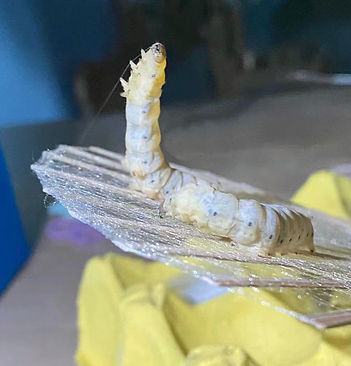
Raw silk threads can be broadly understood to be silk directly from the silkworm’s mouth. In my works, amongst various other techniques, I direct silkworms to spin silk on my paintings instead of producing their usual cocoons. This technique was introduced to me by the silk farmer I had been working with. According to him, Liang Shao ji, another artist who works with silk developed this technique to ‘direct’ silkworms to spin silk on and around a variety of surfaces and objects, rather than producing their usual cocoons.
"Through the manipulation of sound, music, light, temperature, manmade materials and smell, we are able to guide, alter and even transform the paths by which silkworms spin, and create the sculptural forms by twining and piling up their threads."
-Silk farmer ( would like to stay anonymous )
Alongside silk fibres. I use this form of silk in my work
An extremely thin strand of silk is produced from the silkworm's mouth.The strand of silk is flexible but extremely fragile (Xia Xia jiang, 2023).
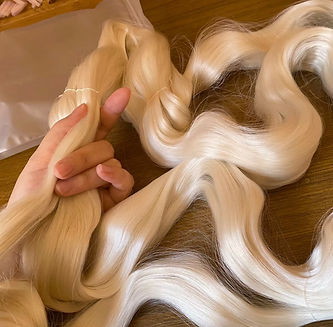
Processed silk threads are threads that are carefully unraveled from cocoons. This can be done by silk workers or automated machines. The loose end of the single strand of silk within the cocoon is located using a brush (Sewport Support Team, 2019).
Processed silk threads are shiny. However, they are also more fragile as compared to cotton threads (Jiu shi na zhi gua, 2022)。
This loose end is then inserted into a reel, allowing for the controlled unraveling of the silk strand (ke ke suan nai, 2022).The following video shows the process of how processed silk threads are made (Sewport Support Team, 2019).
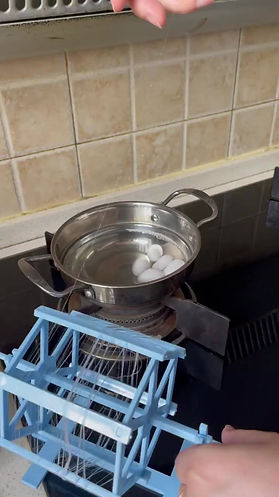
On the other hand, while silk fibres are also derived from cocoons, the production process is vastly different from the above (er shu zao fang, 2022). The video below displays the process. Alongside unprocessed silk threads, I use this form of silk in my work. Depending on the pigments used, or my preferences, I might or might not stretch a layer of silk fibre across the surface before placing the live silkworms on the surface.
Lastly, silk fabric is the textile we typically see in stores. I use this as my canvas.
Key notes
Through a series of setbacks and challenges, I gleaned invaluable insights about silkworms, silk production, and the fabric itself.
-
Diet of the silkworm impacted the color of the silk produced. Initially, I was unaware of this and fed my silkworms leaves that I could find around me. Later, I found out that silkworms must only be fed mulberry leaves. If they are fed other leaves, the resulting silk will be yellow.
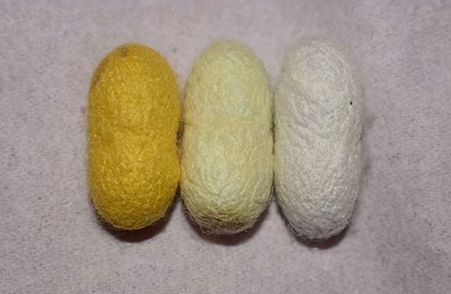
2. When the silkworm begins spinning a cocoon, it moves its head in a figure-eight-shaped pattern.
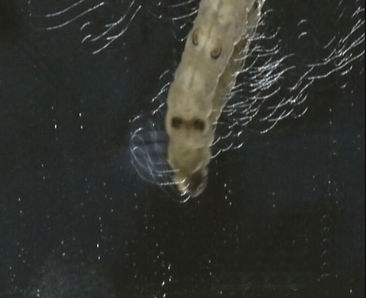
Silkworm spitting silk in the shape of an '8'
(yi gen teng shang qi ge zi, 2021)
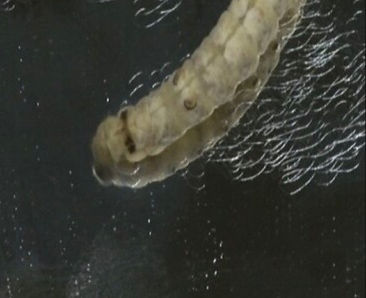
Silkworm spitting silk in the shape of an '8'
(yi gen teng shang qi ge zi, 2021)
3. I find that in cold weather the silkworm changes its movement and the shape of silk becomes looser
4. The silkworm’s spinning is controlled by its biological clock
5.Silkworms are sensitive to smell. They do not like the smell of human body
BBC (n.d.). Dukkha, anicca and anatta - Life and teachings of the Buddha - Edexcel - GCSE Religious Studies Revision - Edexcel. [online] BBC Bitesize. Available at: https://www.bbc.co.uk/bitesize/guides/zd8bcj6/revision/5.
er shu (n.d.). Amazing! Handmade silk soap. er shu zao fang. Available at: http://xhslink.com/HMTn5J [Accessed 22 Mar. 2024].
er shu zao fang (2022). 惊艳!纯手工制作蚕丝皂,洗脸就是舒服. 小红书. Available at: http://xhslink.com/NfdzgK%EF%BC%8C%E5%A4%8D%E5%88%B6%E6%9C%AC%E6%9D%A1%E4%BF%A1%E6%81%AF%EF%BC%8C%E6%89%93%E5%BC%80%E3%80%90%E5%B0%8F%E7%BA%A2%E4%B9%A6%E3%80%91App%E6%9F%A5%E7%9C%8B%E7%B2%BE%E5%BD%A9%E5%86%85%E5%AE%B9%EF%BC%81.
Jiu shi na zhi gua (2022). 关于我用桑给蚕丝线染色. 小红书. Available at: http://xhslink.com/OthwgK%EF%BC%8C%E5%A4%8D%E5%88%B6%E6%9C%AC%E6%9D%A1%E4%BF%A1%E6%81%AF.
ke ke suan nai (2022). 第一次尝试抽蚕丝. 小红书. Available at: https://www.xiaohongshu.com/explore/629715d80000000021038ec5?app_platform=ios&app_version=8.28.1&share_from_user_hidden=true&type=video&author_share=1&xhsshare=CopyLink&shareRedId=ODozQzg8Njw2NzUyOTgwNjc0OTk2SDhP&apptime=1716547913.
Meng, X., Zhu, F. and Chen, K. (2017). Silkworm: A Promising Model Organism in Life Science. Journal of Insect Science, [online] 17(5). doi:https://doi.org/10.1093/jisesa/iex064.
Ng, D. (n.d.). Singaporean Artist Dawn Ng Shares How Her Personal Journeys Inspire Her Works of Art. [online] DAWN NG. Available at: https://www.dawn-ng.com/press/singaporean-artist-dawn-ng-shares-how-her-personal-journeys-inspire-her-works-of-art/# [Accessed 21 May 2024].
OpenAI ChatGPT (2024) ChatGPT response to Esme Tan, 13 May
Sewport Support Team (2019). What is Silk Fabric: Properties, How its Made and Where. [online] Sewport. Available at: https://sewport.com/fabrics-directory/silk-fabric.
Xia Xia jiang (2023). 夏天真不给自己来一把蚕丝扇咩. [online] www.xiaohongshu.com. Available at: http://xhslink.com/dT1ugK [Accessed 18 May 2024].
yi gen teng shang qi ge zi (2021). 蚕丝弥漫,载思载咏_梁绍基_作品_创作. [online] m.sohu.com. Available at: https://m.sohu.com/a/509332014_121124747/?_trans_=010004_zyllqxtmrfx [Accessed 17 May 2024].
Grammar corrected by ChatGPT