


Reason for my interest in silk
Silk is a crucial aspect of my practice for various reasons.
Firstly, there is just something unique about silk's translucency and fluidity that captures memory's elusiveness and unreliability. Much like silk, memories always seem to be on the verge of slipping through my fingers. As silk gently slides across my skin, threatening to tear if I were to exert force, I also see a symbolism of the ephemerality of the past—a paradox of both the fragility and strength of memories, just like silk. Silk also has a fantastic ability to retain scent, causing the natural scent of silk to become intertwined with various memories. This gives silk the ability to transport me to moments of the past.
Secondly, as a Peranakan, silk is a huge part of my culture. Southeast Asia, especially Singapore, has always been a trading hub, resulting in the simulation of cultural exchange. According to the Peranakan Museum, "merchants and other travelers have connected the region to China, India, the Middle East, and Europe. Many of these people settled in Southeast Asia and intermarried into local communities, creating vibrant hybrid cultures that today are widely referred to as Peranakan" (Peranakan Museum, n.d.).
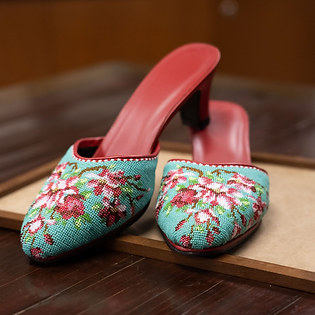
An important part of Pernakan culture is our beaded shoes, which is a traditional footwear. The shoes are made from various materials, particularly silk, and can take years to complete.
Example of Peranakan beaded slipper (our grandfather story, n.d.)
These shoes often carried generational memories. They were passed down from mother to daughter as heirlooms and were often only worn on important occasions such as weddings (maneknya, n.d.). Hence, to me, silk has a deep relationship with memory.
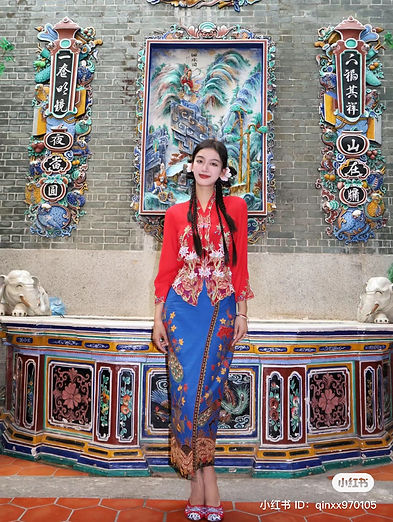
Example of a girl wearing the Pernakan beaded slipper with the Nyonya kebaya ( traditional outfit also made from silk) (Cooli, 2023)
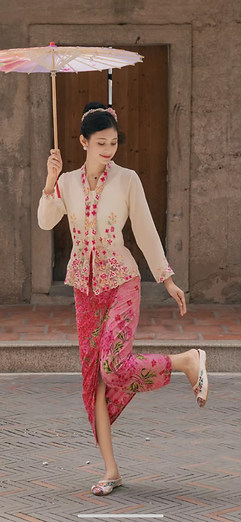
Example of a girl wearing the Pernakan beaded slipper with the Nyonya kebaya ( traditional outfit also made from silk) (Cool, 2023) (shi mian jia lv you, 2023)
Lastly, the nature of silk is that it is impossible to correct any mistakes. Hence, this forces me to trace my memory formation process more carefully. It also forces me to decide what to do when I make a mistake. Do I attempt to cover it? Do I start all over? Do I accept the mistake as part of my memory formation process? Such uncertainties give rise to more possibilities in my practice. Also, when I encounter aspects of memories I cannot recall, the beautiful sheen of raw silk makes it possible to leave the space ambiguous and uncovered by paint.
Types of silk
The main types of silk I experimented with are Uzbek Margilan Silk Gauze, Uzbek Margilan Silk Rarefield, Habotai, Silk Paj, Pongee, and Organza.
Uzbek Margilan Silk Gauze and Uzbek Margilan Silk Rarefield are too delicate to stretch. Additionally, the material's texture makes it unsuitable for wet painting.
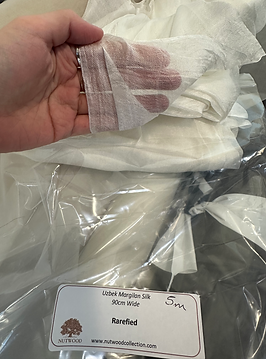
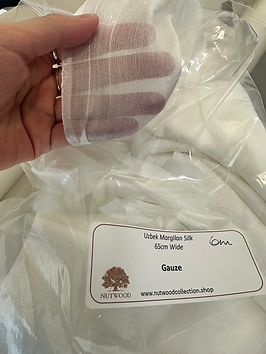
Uzbek Margilan Silk Rarefield
Uzbek Margilan Silk Gauze
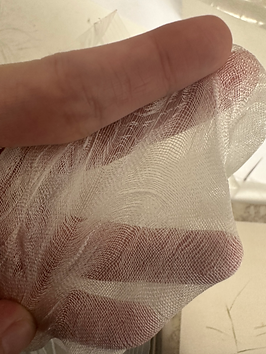
Closeup of Uzbek Margilan Silk Rarefied- can see how the fabric reacts to stretching
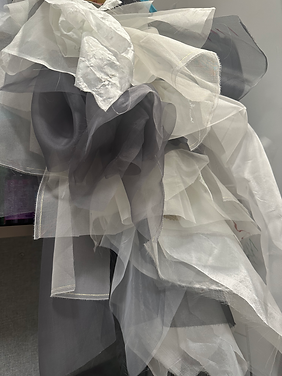
Organza is slightly stiffer than Habotai, Silk Paj, and Pongee. The advantage of organza is that it retains its sheerness while being stiffer and more robust than many other types of silk. There are also many types of raw organza with different transparency and opacity to suit my needs. Some organza is more sheer than Habotai, Silk Paj, and Pongee. There are also organza with almost the same translucency as Habotai, Silk Paj, and Pongee. Hence, the benefit of working with organza is that once I can master the technicalities of the fabric, I can efficiently work with organza of other translucency, too.
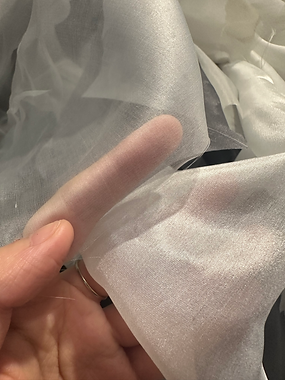
On the left is organza, on the right is habotai. I am not sure if it's evident in the photo but you can visibly see in real life that habotai is more shiny than organza.
It essential to use raw silk organza instead of polyester organza. Polyester organza has a "plastic" texture that makes it challenging for pigments to stay on the surface, even with sizing.
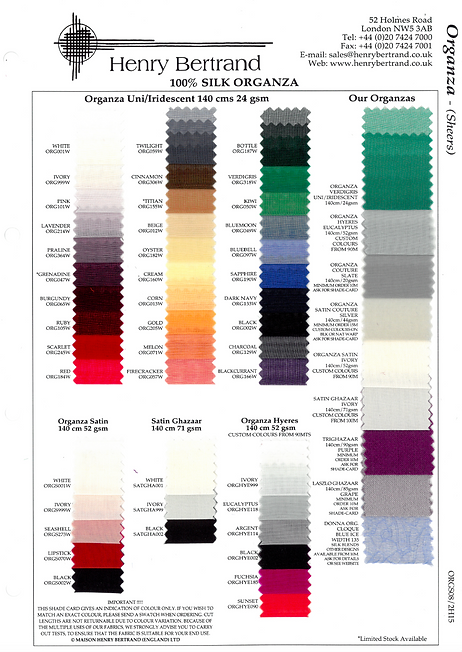
Tester card showing the various types of organza
There are many different types of organza. In particular I work with organza tieton, normal organza , organza ghazar and organza satin. The sheerness of each fabric are ranked
Organza tieton> normal organza> organza satin> organza ghazar
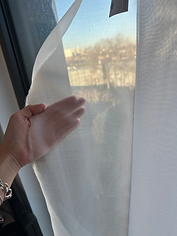
Organza tieton
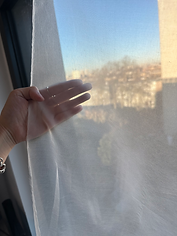
normal organza
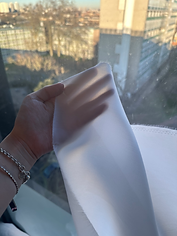
organza satin
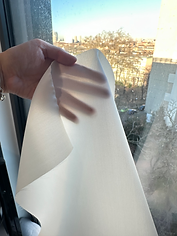
organza glazer
Process of working on silk
-
The process of working on silk almost always begins with ironing the fabric flat. Most silk pieces on the market come with folds. When ironing, it is important to wet the fabric sufficiently to prevent burning.
-
Depending on what I plan to achieve, I will then decide if I want to size the silk. If I hope that color spreads, I will not size the entire silk canvas. However, if I want to achieve clean lines, I will start my painting process by sizing the fabric. According to my various trials and errors, the primary types of sizing that can be used on organza are archival glue, acrylic sizing, and fixative.
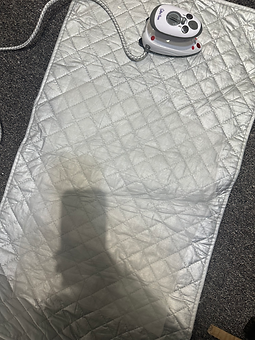
Ironing set- the iron chosen must have the function of heat control and no steam
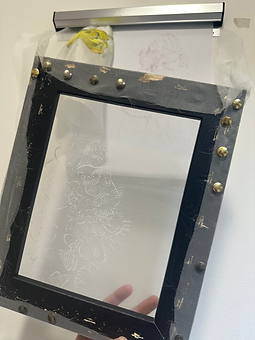
An example of how I stretch the canvas. However, there are many ways depending on what I desire to achieve.
Types of sizing material
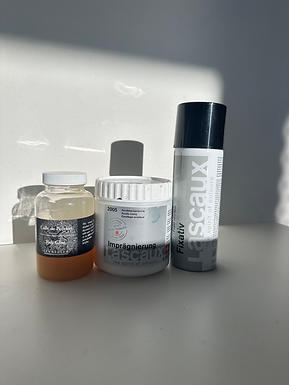
The major type of sizing that can be used with organza are glue,acrylic sizing and fixative.
In the following test below, from left is right is :
Fish glue, Acrylic sizing (undiluted), Acrylic sizing (diluted), Fixative
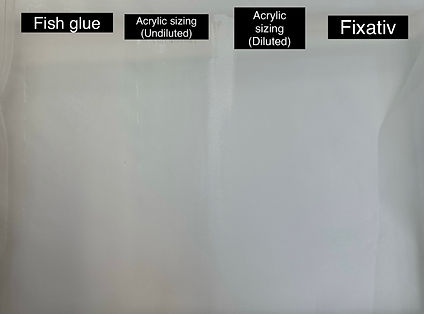
Due to the sheerness of organza silk, it is challenging to capture the effect of sizing. However, it is important to note that fish glue creates a beautiful shimmer on silk. Acrylic sizing must be diluted or else it leaves a white mark. Through my experience, it is also advisable to paint the sizing on the opposite side of the silk. This is especially so when working on organza ghazar. Somehow when water drips onto the fabric, if the sizing is on the top surface, it has a tendency to cause the sizing to spread and dilute. This is especially obvious with fish glue.
Sizing material that I have yet to test
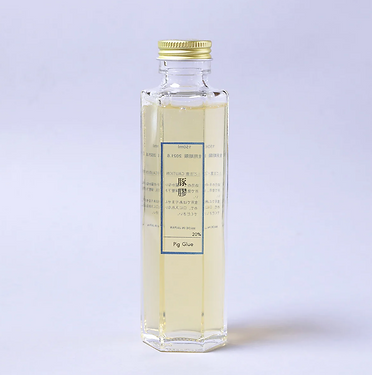
Last week, a Japanese artist who works on silk introduced me to pig glue as a possible sizing material. I think it is rather interesting, and it is a sizing material I would like to try in the future.
Types of binders
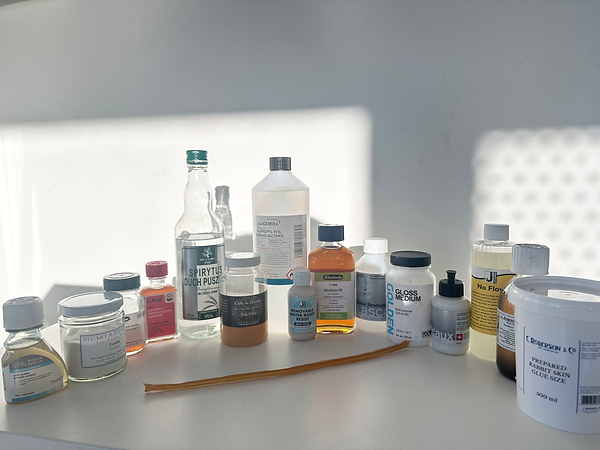
I work with various painting materials on silk, including inks, oil paint, acrylic paint, milk paint, and pigments. When it comes to pigments, the binder makes a huge difference. In terms of binders, I have experimented with a whole array .
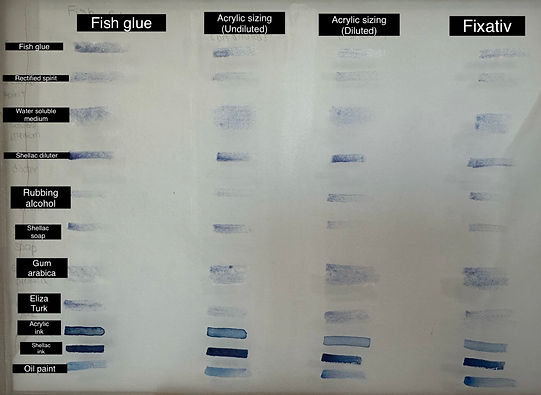
I have experimented with many binders. This photo shows a test of these binders on silk with 'smalt dark pigment'. Inks are the most opaque, alcohol leaves a powdery finish, and glue leaves a shimmer. The shimmer left by a water-soluble medium can be muted with Lascaux medium 2.
Other materials I have experimented with include Sumi ink, Fine soot ink, and walnut ink. Sumi ink is pre-diluted; hence, we cannot control the concentration. It also tends to dry gray instead of black on certain silk fabrics. When using Sumi ink, it is advisable to size the fabric. The benefit of fine soot ink is that users can control the concentration of the ink. Walnut ink can be diluted with water to stain the fabric.
In terms of ink, I find shellac ink more concentrated than acrylic ink or other ink. However, this might also be due to the brand of shellac ink I am using, as I find that different brands of shellac ink have different opacities. This is a minute difference, as shellac ink can be diluted. However, I favor shellac ink over acrylic inks. There is a very “plastic” feel to acrylic inks.
Binders that I have yet to test
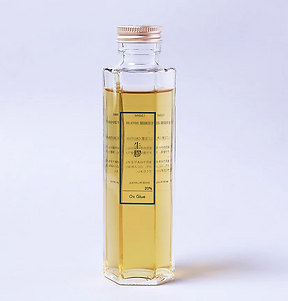
The same Japanese artist who introduced me to pig glue also introduced ox glue to me as a possible binder. According to her, it is suitable for me as I use mineral pigments.
Since ox glue is boiled down with an open flame, it has a high viscosity and therefore is ideal for binding rough grained paints such as Iwaenogu (mineral pigments).
In the future, I will definitely try this binder.
Failed pieces
As I have not painted on silk in the past, I struggled a lot in the initial stages. The following shows some failed pieces.There were actually many more failed pieces. However, I never expected myself to fail so many times. Hence, I threw many of those pieces away.
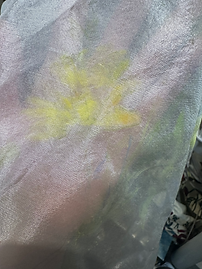
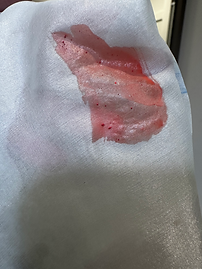
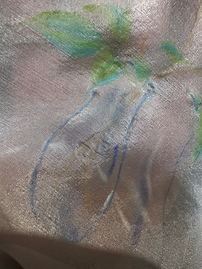
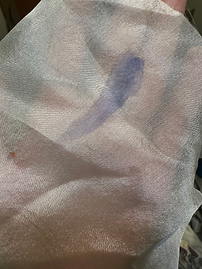
Pigment not gripping well onto the fabric
Unsuitable binder causing the fabric to harden
Unsuitable handling of silk, causing the fabric to tear
Bleeding of paint
A record of some of my failed attempts
Final thoughts
I will be the first to admit that the journey of material research was not easy. When I first started I did not even know how to size silk or why when I ironed my silk, the silk scrunched up. I was very confused why when I tried implementing the methods showed in books/ online, it did not work. I also spoke to many technicians and staff at art material shops but most of them were not familiar with silk. Or if they had tried working on silk before, they were more focused on abstract pieces and were not looking to achieve clean lines on silk. My first major break through was when I spoke to John from AP Fitzpatrick Fine Art Materials. I was not planning to buy art supplies that day, I just happened to walk pass the shop. But I guess it is fate that I walked into the shop that day. John introduced me to an artist called Mindy Lee who also worked on silk and shared with me her silk preparation process.
He helped answer many of my questions such as:
Why even though I was previously already using acrylic sizing as a medium as recommended online, it did not work for me (turns out for silk it has to be diluted)
He also introduced me to Maison Henry Bertrand, a silk shop that has been in business since 1885. There I met the daughter of the shop's owner. She is also an arts student. So when I shared with her my struggles, she was able to answer my questions.For example, she explained to me how different silk reacted to different irons, and that when working with silk, wax can be very useful.
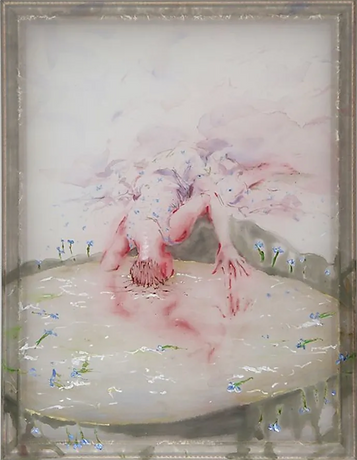
Example of Mindy Lee's work (art rabbit, n.d.)
art rabbit (n.d.). Stories From Within - Solo Show by Mindy Lee - Exhibition at Art Space Portsmouth in Portsmouth. [online] ArtRabbit. Available at: https://www.artrabbit.com/events/stories-from-within-solo-show-by-mindy-lee [Accessed 25 Jan. 2024].
Cool (2023). 🇲🇾马来西亚|是谁家的小娘惹跑出来啦. [online] 小红书. Available at: http://xhslink.com/2M92cA [Accessed 25 Jan. 2024].
maneknya (n.d.). Handcrafted Peranakan-inspired shoes & lifestyle products, made sustainably. [online] www.maneknya.com. Available at: https://www.maneknya.com/history [Accessed 24 Jan. 2024].
Mattei, S.E.-D. (2022). Kim Jung Gi, Famed Illustrator Known for Densely Populated Scenes Drawn in Front of Dedicated Fans, Dead at 47. [online] ARTnews.com. Available at: https://www.artnews.com/art-news/news/kim-jung-gi-illustrator-dead-1234642101/.
our grandfather story (n.d.). Little Shophouse – Our Grandfather Story. [online] OUR GRANDFATHER STORY. Available at: https://ourgrandfatherstory.com/brands/little-shophouse/ [Accessed 25 Jan. 2024].
Peranakan Museum (n.d.). About The Peranakans. [online] www.nhb.gov.sg. Available at: https://www.nhb.gov.sg/peranakanmuseum/learn/about-the-peranakans [Accessed 24 Jan. 2024].
Proko (2019). How to Draw like Kim Jung Gi. [online] www.youtube.com. Available at: https://youtu.be/DmqFbgKWoao?si=8_8G36M5Sdi_8ZCt [Accessed 24 Jan. 2024].
shi mian jia lv you (2023). 泉州,后劲太大了!后悔没早点看到这篇攻略. [online] 小红书. Available at: http://xhslink.com/gVh3cA [Accessed 25 Jan. 2024].
Wider, C. (2018). Drawing from Memory. [online] Learn to Draw and Color with Cindy Wider. Available at: https://drawpj.com/drawing-from-memory/ [Accessed 24 Jan. 2024].