


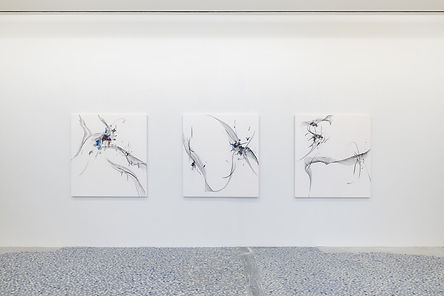
*Click on the photographs for an in-depth explanation of each painting


Lilacs Baptized in Blueberry Butter
Title: Lilacs Baptized in Blueberry Butter
Material: Lace, pigments, shellac, conte, chalk on silk, gold, acrylic panels
Size: 50 cm x 50 cm
Year: 2024
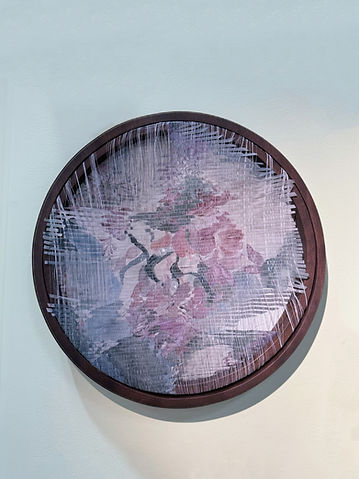
This work draws on the lessons learnt during the Summer exhibition. I found myself eager to explore more possibilities of weaving post- summer exhibition. I was not satisfied with the work 'Beneath the Vein of Drooping Lashes' presented during the summer-exhibition:
Firstly, I feel that unlike my usual paintings, weaving works requires more colors. This is because lines are not visible once the silk has been fragmented into strips and further disrupted with the linen threads of the loom. Hence, in this particular painting, I wanted to try adding more colors to my canvas.
Additionally, I was unsatisfied with the framing I used during the summer exhibition. During the Copeland Gallery Exhibition, one feedback I received was to experiment with free hanging works. This is because of the ephemeral , 'hard to grasp' nature of memory and time. After I attempted free-hanging works in 'Beneath the Vein of Drooping Lashes', I came to a conclusion that I do not like the outcome. Perhaps it is because the fabric I hung was not big enough, or it is because the paintings itself were not up to my expectation.
The process of creation for this piece is similar to the weaving piece in 'Beneath the Vein of Drooping Lashes':
painting on the silk via memory drawing (without prompt) -> painting on the silk via memory drawing (with prompt)-> cut up the silk into strips of about 0.5cm -> weave the silk strips together
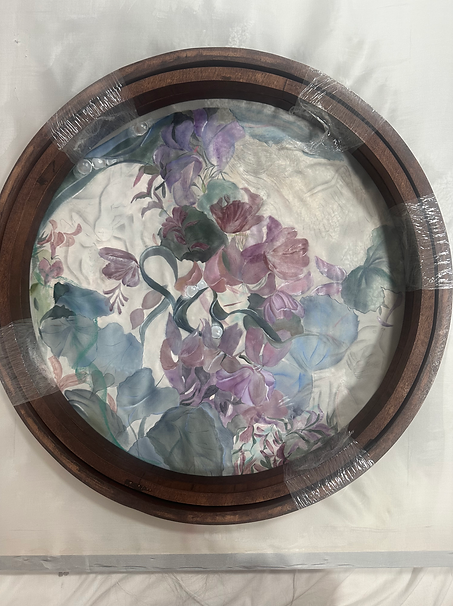
The first step is painting on silk
Close up shot of painting (STEP 1)
My visit to Venice inspired this painting.
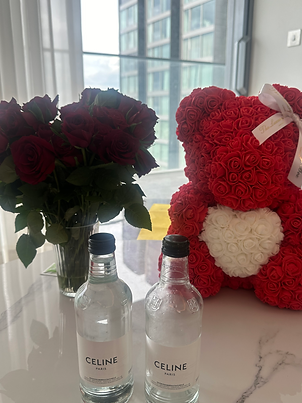
In this painting, flowers take center stage. This is partially inspired by the vase of flowers in my hotel room during my trip to Venice. We bought flowers on the way back to the hotel from a local market, and changed the flowers in the vase daily
Flowers in my hotel room
Flowers also represent intimacy, memory, and the articulation of time:
Similar to silk production, a flower's life cycle, from blooming to withering, mirrors the passage of time (Bromhall, 2018). Other artists who borrowed from the life cycle of flowers to articulate their message include Azuma Makoto, in her "A Story of Flowers" series.(CERCLE, n.d.),
A Story of Flowers, Azuma Makoto
Building on the concept of the articulation of time through the life cycle of a flower, the symbolism of flowers also extends to the realm of memory. Flowers, though beautiful, are known to have a fleeting existence. This nature of flowers allows it to serve as a poignant reminder of intimate memories. This is especially so, as flowers have traditionally been associated with intimate memories (BBC, n.d.). They are often given as tokens of affection during important life events such as weddings and funerals (BBC, n.d.).
Apart from flowers, pearls are also a central element of this piece. One reason I chose to include them is because my mom wore pearl earrings during our visit to Venice, and they appeared in all our photos, making them a memorable part of that trip when I think back.
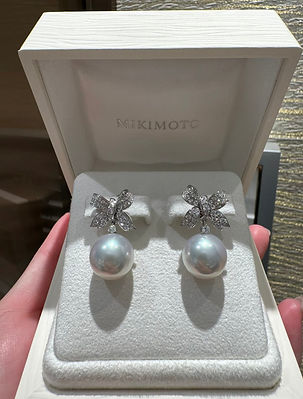
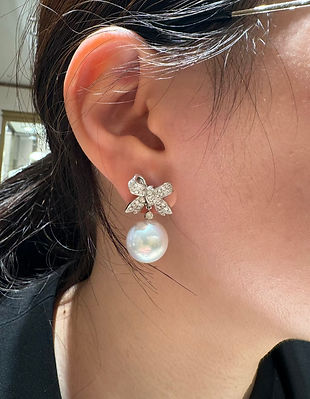
The design of the pearl earrings my mom wore in Venice
How the earrings look like worn
Another reason is that during the Venice Biennale, I saw an artwork by Kang Seung Lee, a multidisciplinary artist born in South Korea which combines flowers and pearls (La Biennale di Venezia, n.d.). I found it highly aesthetically pleasing, making it my favorite piece of art in the Biennale.
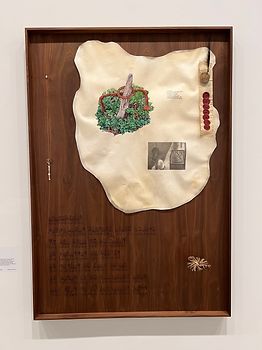
Kang Seung Lee's work @ Venice Biennale
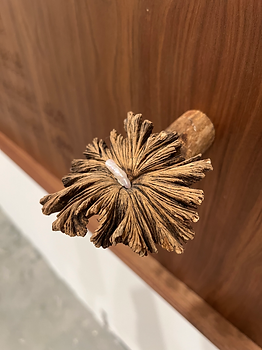
Detailed shot of Kang Seung Lee's work @ Venice Biennale
In this work, I continued using overlapping lines to represent various memory fragments, consolidating lessons learned from the summer exhibition.
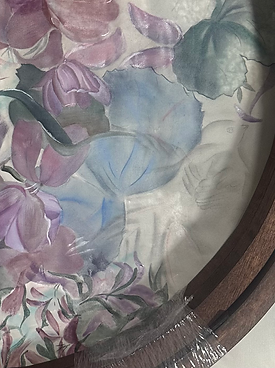
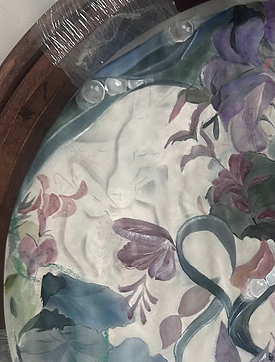
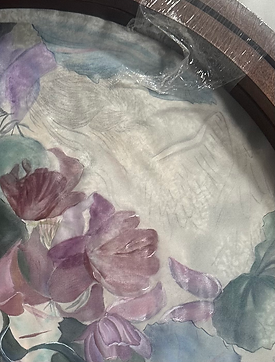
Photographs of details of the painting
I experimented with shading instead of pure lines to ensure the images would remain visible after cutting the silk into strips.However, the images still did not remain visible after the process of cutting and weaving.
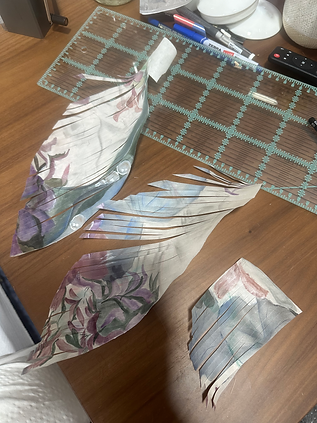
Step 2: I cut up the silk into strips of about 0.5cm.
As mentioned under 'Beneath the Vein of Drooping Lashes' , This step represents the fragmentation and compartmentalisation of memories.
This act of cutting also symbolizes the passage of time and the way moments are dissected and preserved in our minds.
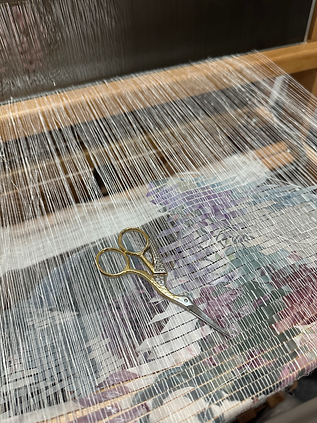
Step 3: I weave the silk strips together.
As elaborated under 'methods, processes and materials', the act of weaving itself acts as an articulation of time in my work
I chose a circle-shaped frame for this work. This was inspired by the round windows I saw in Venice, whcih are often found in Venetian architecture.
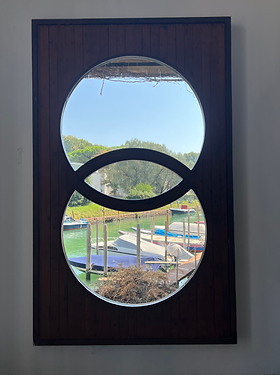
Round windows seen at the Venice Biennale main building
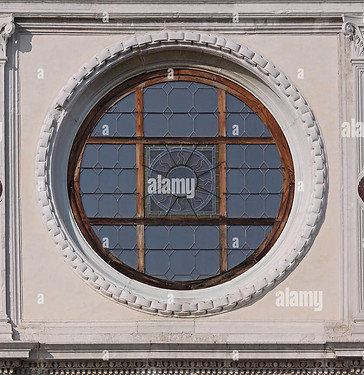
Round Window at Catholic Church in Venice (Alamy Limited, 2024)
Supporting Work
Video
***please click to play***
Sketch
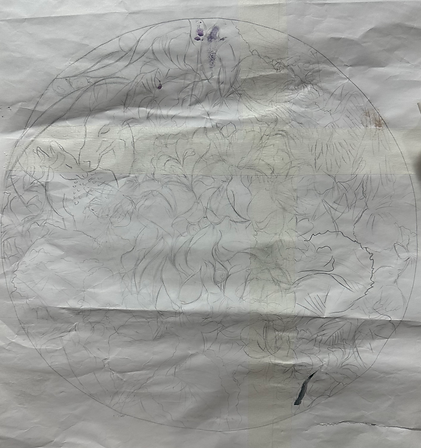
Experimentation
I experimented with various tools to achieve the consistent, regularly shaped silk strips seen in my work .
This includes the Lace Cutter tool:
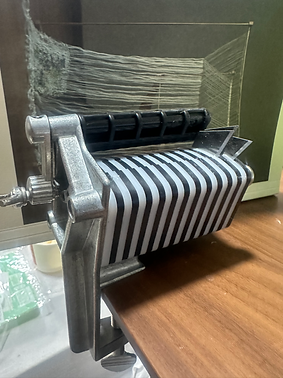
Tool
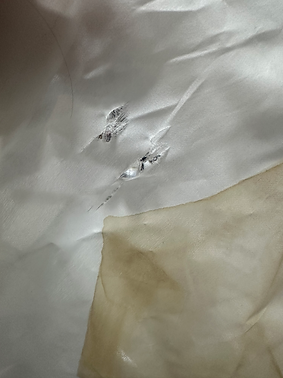
Outcome
The lace cutter did not work well for me because of the unique nature of silk. When I passed it through the lace cutter, it started fraying.
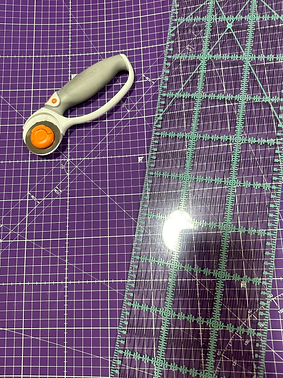
Tool
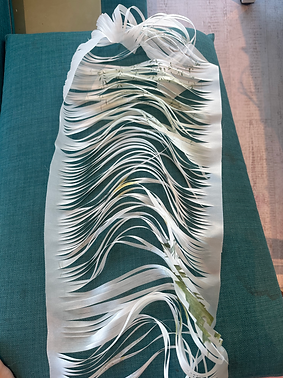
Outcome
On the other hand, the rotary cutter was a much more handy tool
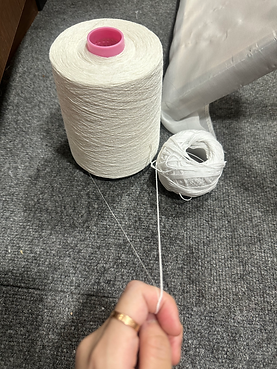
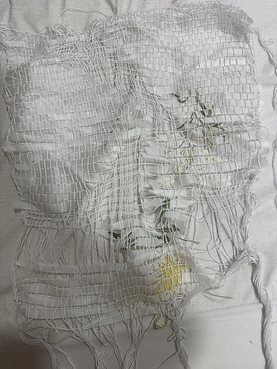
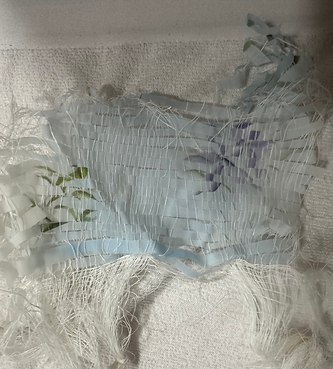
I experimented with various thickness of threads used on the loom. I tested threads from various suppliers. The thickness of the thread is important as it affects the visibility of what is painted on the silk strips. Eventually I settled on the linen produced by Jos Vanneste. Jos Vanneste is internationally renowned for the production of his "cottonised flax fibers, flax tops, classification & distribution of long and short staple flax and sells of various counts of 100% linen yarns" (Jos Vanneste, 2019). I was introduced to this supplier by Elise Peroi ( who I also briefly mentioned under critical reflection). The linen produced by this supplier is thin enough that it does not influence the images painted on the silk strips, but yet is strong enough to not break when used on the loom.
Affordable Art Fair

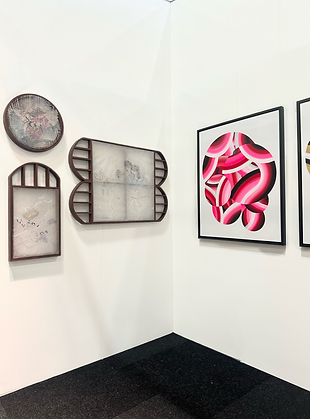
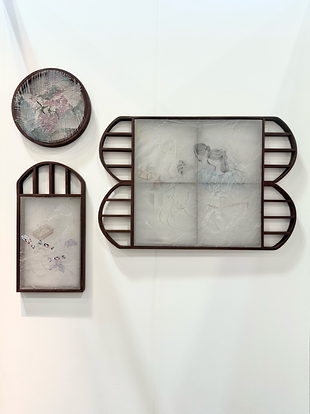
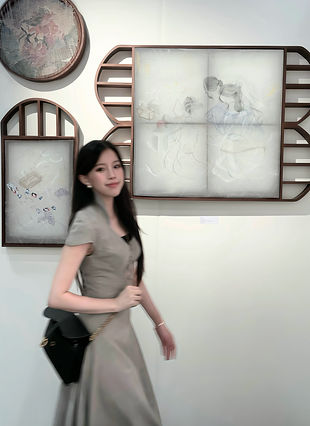
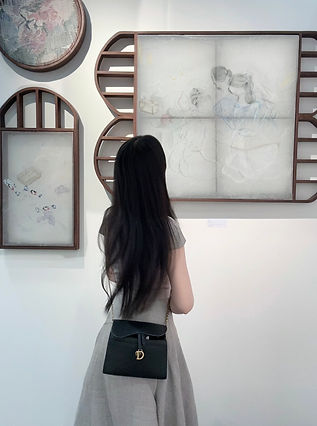
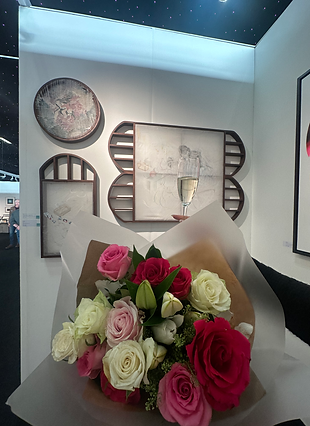
I took part in the Affordable Art Fair this October (utilising works from the summer exhibition, as well as 'Lilacs Baptised in Blueberry Butter' ).
This was my first art fair. It was an exciting experience as it was my first time participating in an art-related event focused on sales. Even though there was a sales team in charge of marketing and sales, I still helped out at the booth to gain some experience.
During the Summer Exhibition, I was also present during the private view and had the chance to enagage with the audience. However, I could feel a vast difference in the questions asked during the summer exhibition and the art fair. During the summer exhibition, the questions asked were primarily targeted at my practice. In contrast, during the art fair, the questions surrounded the upkeep of the pieces. One question that repeatedly came up was: Given that silk fibers are coating the surface of the canvas, how can I keep the dust away?
Before the art fair, I had never considered my practice from this angle. I raised this topic during a group critique with my classmates, and we had an interesting discussion regarding commerciality vs artistic integrity. One of my classmates mentioned that Jason Horejs once wrote for his blog, "Artistic integrity is your most valuable asset. It's about presenting something fresh and genuine to the world" (Horejs, 2024). However, it is also important to note that sometimes, maintaining artistic integrity is a privilege some do not have.
The conversation soon took a sharp turn into the complexities of the commercial aspect of the art world. My classmate Xin Yi, whom I visited Art Basel ( Hong Kong) with a few months back, mentioned that she realized that in the Asian art market, sometimes, when an artist has achieved a degree of success, they become hesitant to take risks, making their paintings repetitive over time.
This reminded me of artists such as Sonia Jia and Xiyao Wang , who has faced similar criticism from art critics.
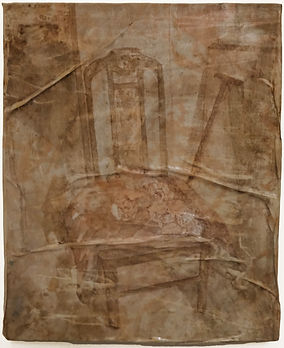
Corner, Sonia Jia (Jia, 2024)
A Little Story No. 1/Adagio No., Xiao Wang (Wang, 2024)
Back
Forward
Alamy Limited (2024). Round Window at Catholic Church Venice Italy. [online] Alamy.com. Available at: https://www.alamy.com/round-window-at-catholic-church-venice-italy-image247264512.html [Accessed 20 Nov. 2024].
BBC (n.d.). Five flowers that made history. [online] BBC Bitesize. Available at: https://www.bbc.co.uk/bitesize/articles/zrs68xs [Accessed 20 Nov. 2024].Bromhall, N. (2018). Rose 3 buds opening into flowers & dying time lapse. [online] YouTube. Available at: https://youtu.be/flg0CoirE2M?si=gvqQXeyoR3tNkO7e [Accessed 20 Nov. 2024].
CERCLE (n.d.). ‘A Story of Flowers’: the flower life cycle by florist artist Azuma Makoto. [online] Cercle. Available at: https://www.cerclemagazine.com/en/magazine/articles-magazine/a-story-of-flowers-the-flower-life-cycle-by-florist-artist-azuma-makoto/ [Accessed 20 Nov. 2024].
Horejs, J. (2024). Striking the Perfect Balance: Artistic Integrity and Commercial Success. [online] RedDotBlog. Available at: https://reddotblog.com/striking-the-perfect-balance-artistic-integrity-and-commercial-success/ [Accessed 20 Nov. 2024].Jia, S. (2024).
SONIA JIA - 2024. [online] Myportfolio.com. Available at: https://soniajia.myportfolio.com/2024 [Accessed 20 Nov. 2024].Jos Vanneste (2019). Production of European flax fibers, already yet for 4 generations. [online] Jos-vanneste.com. Available at: https://www.jos-vanneste.com [Accessed 21 Nov. 2024].
La Biennale di Venezia (n.d.). Biennale Arte 2024 | Kang Seung Lee. [online] La Biennale di Venezia. Available at: https://www.labiennale.org/en/art/2024/nucleo-contemporaneo/kang-seung-lee [Accessed 20 Nov. 2024].
Nito Magazine (2022). nito nito | The Ring. [online] nitonito.pl. Available at: https://nitonito.pl/en/article/the-ring [Accessed 20 Nov. 2024].Wang, X. (2024). Xiyao Wang: Paintings. [online] Xiyaowang.com. Available at: https://xiyaowang.com/index.php?id=2&tx_subtilworks_projectsplg%5Bprojects%5D=480&tx_subtilworks_projectsplg%5Baction%5D=show&tx_subtilworks_projectsplg%5Bcontroller%5D=Projects&cHash=4fb2fc6664b6299a6a2487560c8af67c.