


*Click on the photographs for an in-depth explanation of each painting


Critical Reflection
Over the past few months, I explored the intimate symbiotic relationship between humans and their surroundings while articulating the temporality of the passage of time. In harmony with the ebb and flow of time, I also explored concepts related to disappearance and transformation within the fabric of intimate memories.
Intimacy
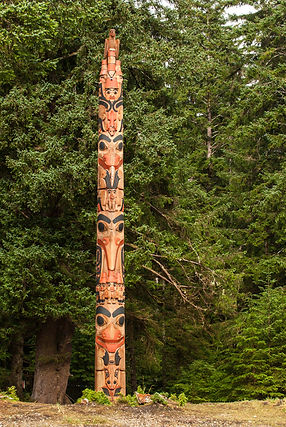
One Summer day a decade ago, my parents and I were invited by a family friend, William, to attend a celebration in Haida Gwaii, an archipelago off British Columbia's west coast (Canadian Sky, n.d.). The festival honors the anniversary of a momentous accord between the Haida people and the Canadian government to safeguard their land from further ecological pillage. A totem pole was going to be raised to commemorate the historic agreement (Government of Canada, 2023).
William, who owns an art gallery in Toronto specializing in Indigenous art, has spent decades building intimate relationships with members of the Haida Nation. In contrast, all we knew about Haida Gwaii was its beautiful ancient rainforest and that it is home to an Indigenous community. Collectively, the community decided that the location where the totem pole would be erected was to be named Gwaii Haanas ('The Islands of Beauty') (Government of Canada, 2023).
The totem pole that was erected (Gibbs, 2014)
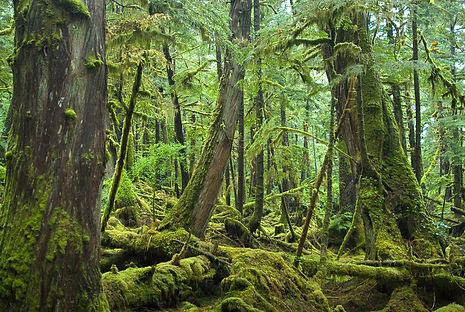
Ten years later, my parents brought me back to the same location. As I stood beneath the trees of Gwaii Haanas for the first time in years, the moment held a feeling of familiarity for me. Golden rays seeped through the thick canopy, and the rainforest bustled with rustling leaves. I felt a deep intimate connection to this place as my memories blended with the present. I found myself experiencing unexpected feelings of nostalgia when I had anticipated only a sense of serenity. The longing for this place was not just about the place but about the intimacy of attachment-based memories blending with the present, recognizing the profound connections with a place formed through time and experience (Ratcliffe and Korpela, 2016).
Attachment to a place is a fascinating notion to me as I have extensively made paintings relying on the significance of the domestic place. Hence, I was unsure if attachment to a place is restricted to a domestic setting for me or if I am able to explore it in a broader scope. During unit 2's feedback, Lecturer Remi reminded me to consider why my most intimate memories are often in a domestic setting. I was pointed in the direction of Gaston Bachelard's exploration into the "significance of the house as a place of protected intimacy" (Bachelard, 1994, p.132). The research paper, 'A critical approach to intimacy in art' by The University of Auckland, dissects Bachelard's writings and explains how there is an "ultimate poetic depth arising from both our memories and imaginings of the space" (Bennett, 2017a).
Gwaii Haanas rainforest (Sierra Club BC, 2019)
The paper quotes Bachelard, further explaining that "the chief benefit of the house" is that "the house shelters daydreaming, the house protects the dreamer, the house allows one to dream in peace" (Bennett, 2017a). I was also pointed to the possibility of place attachment. In the book Place Attachment by Devine-Write and Manzo, place attachment is defined as the 'powerful emotional bonds that form between people and their physical surroundings', resulting in feelings of intimacy (Manzo and Devine-Wright, 2013, p.1977).
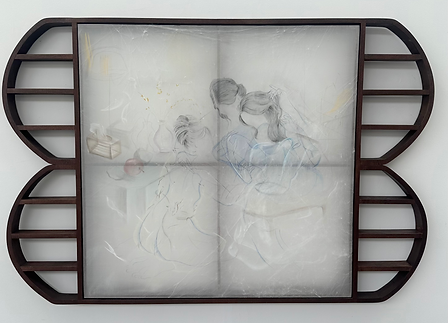
Following my trip back to Gwaii Haanas after 10 years and my initial research, I realized that for me, place attachment extends beyond the confines of domestic settings. It encompasses any environment where personal memories and emotions are deeply intertwined with the space itself. This expanded understanding of intimacy guided my recent works, where I focused on capturing the intimate connections people have with various places, not just my home. For example, the two works 'Written in Water' and 'Wrinkled Time' I showed during the Summer Exhibition were inspired by a wedding I attended in Japan. Additionally, 'Lilacs Baptised in Blueberry Butter' was created in response to my trip to Venice.
My work for the Summer Exhibition: Wrinkled Time
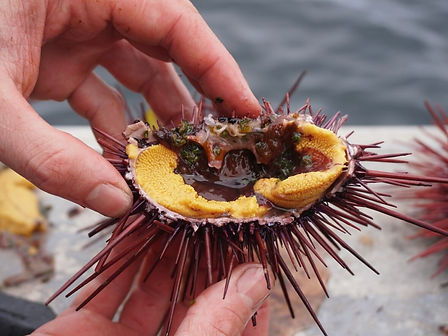
One of my most intimate memories of my trip to Gwaii Haanas 10 years ago was when a Haida woman invited us to try some Guuding ngaay, a traditional dish of the Haida people. I was hesitant, but the lady was insistent. Surprisingly, it dissolved into a briny, sweet, umami blend on my tongue.
Guuding.ngaay (red urchin roe) is a traditional food of the Haida people (Narwhal, 2019)
This visceral memory of senses reminded me of my recent trip to the Venice Biennale, where I visited the Korean Pavilion and experienced Koo Jeong A's "Odorama Cities".
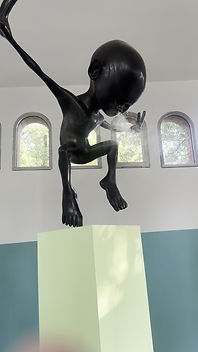
Machine which diffuses scent
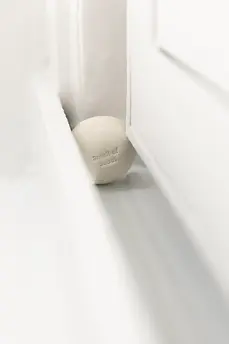
Diffusers of various scents are hidden around the pavilion (Macabasco, 2024 )
This installation used over 600 scents to capture a nation's intimate story. These scents included natural aromas like red pine trees, food-related scents like fermented kimchi, and modern life smells like damp mold (Macabasco, 2024).
The pavilion's serene environment provided a meditative calm in an otherwise overstimulating Biennale. This emphasizes the importance of sensory elements in triggering intimate memories and emotions. I got a further sense of the relationship between meditative calm and intimacy in art when I saw Koo's sculpture again at Frieze. However, I felt no sense of intimacy without the immersive setting and the boost of scent.
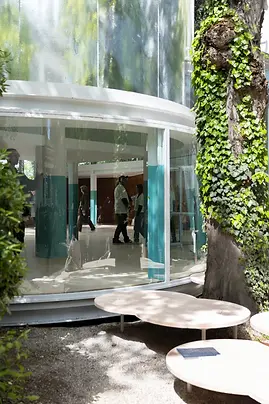
"The Korean Pavilion’s spare serenity puts the focus squarely on the sense of smell."
(Macabasco, 2024).
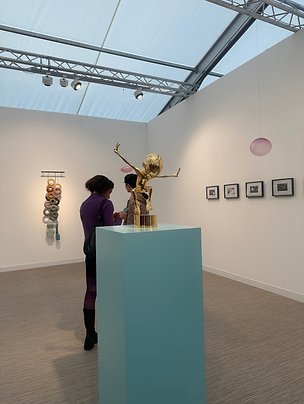
Koo's sculpture at Frieze
Through elements like color, texture, and memory signifiers (etc. iconic childhood candies in 'Wrinkled Time'), I also aim to create environments that evoke a sense of shared intimacy.
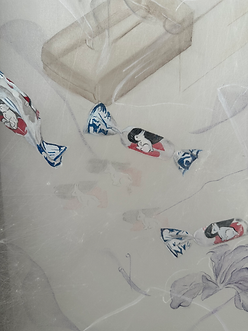
This method fosters a collective sense of intimacy, allowing viewers to 'project their own experiences and emotions' (Aly ZK, 2024). Through playing with sensory aspects and the quality of the 'meditative tranquility', I hope to explore further the boundaries of private and shared intimacy in a public space.
Detailed shot of my work 'Wrinkled Time': White bunny candies are iconic childhood candies in Southeast-Asia
Building on the concept of tranquility, Zeinab Saleh's upcoming exhibition with David Zwirner also shows new possibilities regarding creating environments for the meditative calm (David Zwirner, 2024). Saleh, a Kenyan artist, is known to be able to capture the power of intimacy in everyday life in her work. During Frieze's private view, knowing that Saleh is one of my favorite artists, David Zwirner's curator revealed that, differing from her past works, Saleh's upcoming exhibition will focus on the tranquil depictions of scenes from the domestic world.
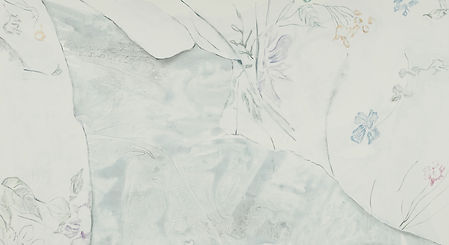
Saleh's new works convey intimacy through tranquility by employing a unique process that starts with "watery washes of hazy acrylic paint", which create a serene, almost ethereal background (David Zwirner, 2024). By "pressing crumpled fabric and plant cuttings onto the canvas, she introduces organic textures and forms" that evoke the intimate tranquility of details of her personal environment (David Zwirner, 2024). This made me ponder about the use of materiality in my own work.
Zeinab Saleh, Three oceans away, 2024 (David Zwirner, 2024)
Tara Walters is another artist who seamlessly blend materiality into her use of meditation and spiritualism to convey tranquility.
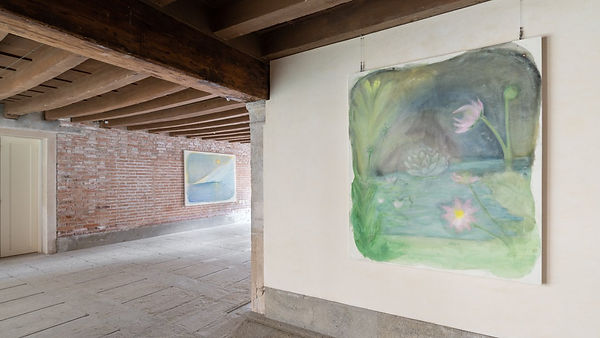
Tara Walter's paintings which were exhibited at Barbati Gallery (Walters, 2014)
She harnesses elements of the material world, such as "seawater, sand, and shell dust", to capture the "fleeting language of our intuition and memory", imbuing her works with a subtle glow that serves as a "starting point of our mind and spirit's voyages" (Walters, 2014).
So far, the experimentation of materiality in my work is targeted at articulating the passage of time. When I think about tranquility, I merely think of the color palette. I have not thought about using materiality to create intimacy through tranquility. This reminded me that during the summer exhibition, my schoolmate, Mriganka, explained how she combined Indian meditation and Egyptian paper to convey the relevant messages in her art. All these culminate in a research paper by Smith, which mentions that "materiality in art can significantly influence the emotional tone of a piece" (Smith, 2022).
This train of thought guides me toward creating an emotional landscape where intimacy is not about direct personal exposure but about evoking a collective sense of shared experience. This is one reason why I wanted to move away from painting human figures after the summer exhibition. Roland Barthes, in "Image-Music-Text" (1977), highlights how specific symbols, including human figures, influence interpretation (Barthes, 1977, p.39). Barthes argues that detailed human figures can limit the range of meanings and personal connections viewers might project onto the artwork. He notes, "The more a symbol is detailed, the more it anchors the meaning, leaving less room for personal projection and interpretation" (Ashfaq, 2023). On the other hand, I used to think that inanimate objects allow for broader interpretation and connection. After all, Sherry Turkle, in Evocative Objects, argues that "We think with the objects we love; we love the objects we think with" (Turkle, 2007, p.5). This suggests that inanimate objects can evoke memories and emotions precisely because of their ambiguity.
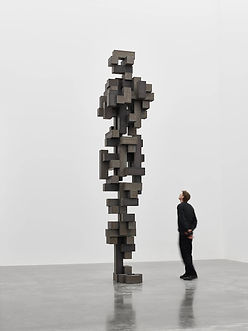
However, this sentiment was soon challenged by Freud's idea that "the body is first and foremost a bodily ego" which emphasizes the "psycho-somatic connection from the beginning", and other artists such as Anthony Gormley who "sees the body as a place of memory and transformation" (Edwards, 2015a). In his own words, "I am interested in the body because it is the place where emotions are most directly registered " (Edwards, 2015a).
Antony Gormley, “Stand,” 2023
(Novi, 2024)
Hence, after much thought, I gave up the idea of completely shifting away from painting human figures. However, when it comes to human figures in art, another sensitive topic of voyeurism in relation to intimacy arises. In the past few months, I explored the complexities of the voyeuristic viewpoint itself being intimate: When the subject appears unaware of being observed, the intimacy of the artwork intensifies.

However, the intricacies of this topic are illustrated in art such as George Hendrik Breitner's photography, whose works clearly target the privileged heterosexual male viewer (Bennett, 2017b). In such cases, intimacy is intertwined with the thrill of revelation. The intimacy between the subject is exposed unbeknownst to them, and "is not being shared or reciprocated by the viewer's voyeurism" (Bennett, 2017b).
Two Women on Bed, 1889-1915,George Hendrik Breitner (AnOther, 2016)
Despite my efforts to be comprehensive in my approach to using human figures in my art, I failed to consciously contemplate that there is a deeper layer to this dynamic.
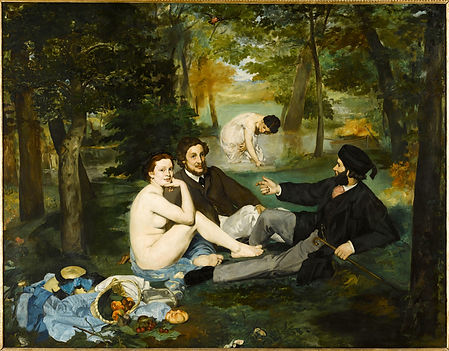
Le Déjeuner sur l'herbe, Edouard Manet (Musee d' Orsay, n.d.)
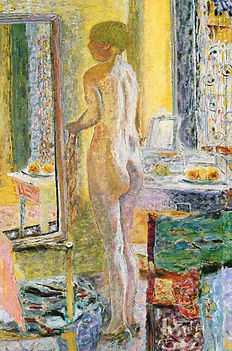
Nude Before a Mirror (1931) by Pierre Bonnard (Archive, 2024)
As Fried discusses in his work, "radical facingness" in works like Le déjeuner sur l'herbe , the viewer is placed directly in the subject's gaze, making the relationship explicit (Bennett, 2017c).In contrast, Bonnard's Nude Before a Mirror offers a more complex intimacy through the subject's absorption in her task, as she is "absorbed in her own self, in thought and in reverie," which allows the viewer to feel a closer, almost empathetic connection (Bennett, 2017c). This aligns with Fried's concept of absorption, where intimacy is not solely about being observed (Bennett, 2017c). It is also about sharing the subject's world through emotional and psychological engagement. In past works, such as 'Written in Water', I do portray subjects engrossed in their personal realms. However, the concept of absorption is not by intention; it is a coincidence that the particular memory painted happened to feature such actions. In the future, I will aim to intentionally explore my subjects' absorption in their own worlds—rather than merely focusing on their awareness of being observed.
Time
Ten years ago, the afternoon before the totem pole was erected, we decided to go for a stroll. We soon reached a giant Western Redcedar, which I later learned to be approximately 1000 years old. Embracing it, I suddenly felt minuscule.
As Robert Moor put it beautifully in words:
"I had been to forests larger than this one, simply in terms of area, but I had never been in a forest this visibly full of time, which is to say, of uninterrupted growth. My mind was too small for it."
-Robert Moor (Moor, 2024)
In Ada or Ardor: A Family Chronicle, Nabokov writes, "We can never know Time. Our senses are simply not meant to perceive it." (Vladimir Nabokov, 2024, p.463). We are used to relying on technology such as hourglasses, calendars, and clocks. This notion had been brewing in my mind, particularly during my visit to Gwaii Haanas, ten years after my first trip. The idea began to sprout in me: perhaps the very tools through which we perceive time influence our perception of it, shaping how we live our lives. This was reinforced by a conversation with a silkworm farmer a few months ago, which led me to my research on the materiality of silk.
The idea that silkworms dedicate their entire lives to silk production, which is a cyclical process, can be a powerful metaphor for exploring the themes of time, memory, the ephemeral, and the fragility of human experience. From its birth to the silkworm's wistful end, every moment is dedicated to silk weaving (BYJU'S, n.d.). After laying eggs and initiating a new cycle of life, it succumbs to fate (BYJU'S, n.d.). Males do not have to lay eggs. Hence, death arrives even more swiftly, almost immediately after mating (BYJU'S, n.d.). Thus, in its sacrifice, the silkworm embodies concepts of time, memory, and the ephemeral. If you give it some thought, you begin to die the moment you are born. This law of nature is obeyed by the cycle of silk production, highlighting the relationship of death with the cyclicality of time—a constant reminder of life's perpetual disappearance and transformation.
When I first started researching the possibility of using silk as an articulation of time, I was focused on its materiality ( physical form and the way it symbolizes cycles of life and death). However, I have come to a realization that it is undeniable that the rhythms of the natural world have a role in the articulation of time. For instance, nature's broader, cyclical patterns (labor, death, and renewal) is mirrored by the silkworm's life cycle. This broader perspective aligns with the insights of Maurice Merleau-Ponty, who emphasized that "the body is our general medium for having a world", suggesting that our physical existence and the natural rhythms around us influence how we perceive and articulate time (Merleau-Ponty, 1962, p.169).
Dawn Ng - Avalanche I (Time Lost Falling in Love)
(Sullivan Strumpf, 2021)
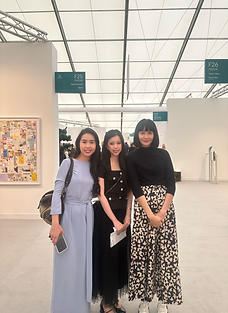
Had the opportunity to meet Dawn Ng at Frieze
Other artists who have articulated time through the rhythms of the natural world include Dawn Ng, whom I had the opportunity to meet during Frieze. Ng documents the melting and forming of ice to articulate the passage of time. In her work, the pigment ice block is a metaphor for a clock and the 'now' (ThroughObjects, 2022). During my conversation with her during Frieze, she admitted that there is a potential "Simulacra" quality to her work. However, in my opinion, this does not take away from her message. Instead, it invites viewers to reflect on their own experiences with time by highlighting the tension between reality and representation.
This alignment of natural rhythms with time reminded me of the Haida nation's traditional customs about the life cycle of trees—a story that, while not central to my research, helped me understand layers of time that can coexist. Just as we measure a tree's age via its concentric rings, so too do silkworms capture temporal layers (Bauer, 2018). My paintings, like the tree's rings, use these layered materials and processes to evoke the complexity and fluidity of time itself. What most people do not know is that: Trees also have a series of horizontal tubes, which transport fluids from the outer tissues of the tree to the inner ones across time, much like the layering of paint, guiding silkworms, and the criss-cross of weaving in my work (Moor, 2024). Hence, "while trees divide time into discrete segments—years, decades, centuries—they also complicate those easy demarcations by allowing the present and past to bleed over to one another", making me think of the ephemeral nature of memories (Moor, 2024). Like the tree's living process, silk's production cycle allows us to see time not as discrete, linear events but as an overlapping, regenerative flow. It also makes me think of how my paintings capture the fluidity of time through the integration of various temporal layers and techniques, such as weaving.
This holistic understanding of time parallels the work of artists such as Hiroshi Sugimoto and Michael Wesely, whose craft sparked inspiration for my own work.
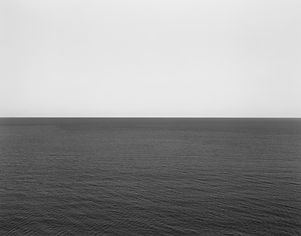.jpg)
Caribbean Sea, Jamaica, 1980 (Seascapes — Hiroshi Sugimoto, 2014)
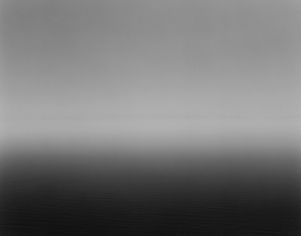
Ligurian Sea, Saviore, 1993 (Seascapes — Hiroshi Sugimoto, 2014)
Sugimoto captures time through his photography by utilizing long exposure techniques and capturing extended periods within a single frame (Xiao, 2024). For example, in his Seascapes Series, Sugimoto captures various oceans and seas under different weather conditions and times of day. Using long exposure, subtle changes over time are captured, creating a blurred effect (Xiao, 2024).
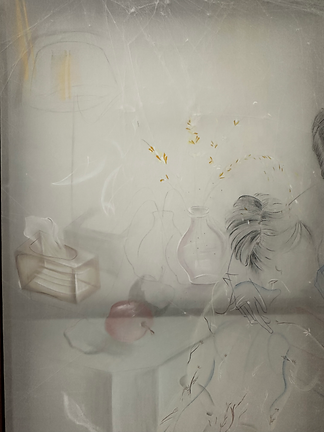
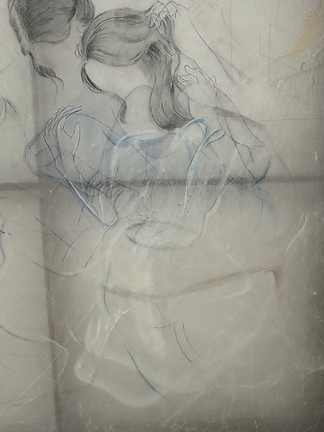
This technique allows Sugimoto to present time as a singular, accumulated experience instead of singular moments. This visual presentation of time's passage made me reflect on how I could incorporate similar elements into my own practice beyond relying on the materiality of silk to articulate time (Xiao, 2024). Sugimoto's photographs, which layer various moments into one image, inspired me to experiment with double-vision effects and overlapping lines in my paintings. This approach allows me to capture a sequence of time within one single frame.
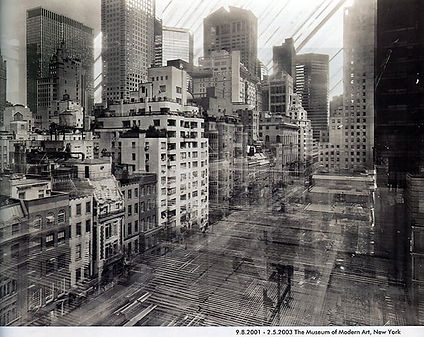
Similarly, Wesely captures time through his iconic long-exposure photography technique. One of Wesely's most notable projects, "Open Shutter," involves photographing the construction of buildings over years (MoMA, n.d.). Through this, Wesely produces photographs that combine static and dynamic elements. Stationary structures such as lamposts appear permanent. On the other hand, movements and changes-including the development of buildings, the passage of clouds, and the changing light—create ghostly, transparent layers.
One work from Wesley's Open Shutter series (Zhang, 2012)
Wesely's documentation of change over time inspired me to think about the fluid, ongoing process of transformation, leading me to incorporate paint of varying densities to suggest movement and continuity.
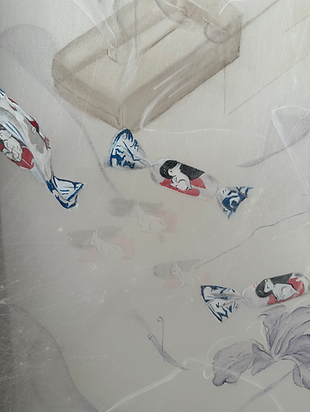
In my work: More dense paint is created with shellac and less dense paint is created with diluted pigment
All these culminate in my eventual exploration into weaving to further develop the overlapping nature of time.
"The loom is seen as a musical instrument made of numerous strings with a sound of silence and a few snaps. The pace of time, the continuing metronome echoes with the gesture which is repeated perpetually in order to complete the work… like a cellist weaving an instant in time, and a weaver working over time.."
-Elise Peroi (Peroi, 2017)
Under 'Methods, processes and materials' and 'Documentation', I have explored how weaving allows for a unique interplay of time, patience, and repetition while also bridging my previous focus on painting and a more textured approach.
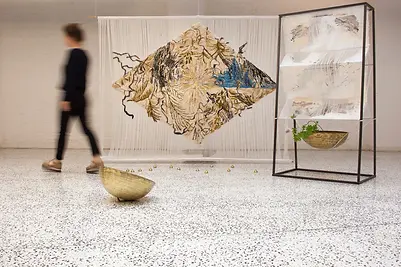
Elise Peroi (elaborated under Additional Content) is an artist who has been instrumental in my exploration of weaving. Through her work based on weaving and opening up spaces, Peroi seeks to translate "what passes through, the breath, the atmosphere" (Irene Laub, n.d.).
Elise Peroi's work at a recent exhibition
(carre fourdes arts, 2022)
Through her, I learned about the symbolism of recurrence (elaborated under methods, process and materials) in weaving, which I then applied to my practice, using weaving to articulate time's layered and fluid nature. She introduced me to Tanya Aguiñiga, who also uses weaving to articulate time.
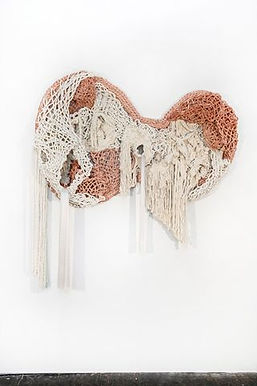
Aguiñiga's practice utilizes weaving as a language to document and resist cultural divisions, highlighting the passage of time through the shared act of creating across borders (Savig and Herman, 2023).
(Savig and Herman, 2023)
Memory
Ten years ago, we were invited to attend a traditional banquet before leaving Haida Gwaii. In honour of his ancestors and those who fought beside him, a Haida leader made an empowering speech. He expressed, "The characters inscribed in our tales have been here in this fight." At that moment, I made a silent vow to "remember forever." Yet, when we came back a decade later, I was shocked by how little the younger generations remembered, partly due to the large amounts of residents that have left the area.
This resonates greatly with my own reason for capturing intimate memories in my paintings—the fear that these fleeting intimate moments would fade over time. However, during a group critique, one of my classmates, Charles, pointed out the transient nature of memories. Sigmund Freud's essay On Transience (1915) illuminated this idea further, particularly his argument that "the value of all this beauty and perfection is determined only by its significance for our own emotional lives" (Edwards, 2015b). Freud suggested that it is precisely this transience that makes all moments precious (Edwards, 2015b). In his words, "transience of beauty does not detract from its worth", instead it provides what he calls "scarcity value in time" (Edwards, 2015b). In other words, acceptance of transcience can make moments more emotionally impactful.This reflection on transience led me to reconsider my initial desire to preserve memories forever. Paradoxically, by acknowledging the inevitable passing of things, including our own lives (eventual death), we could perhaps accept the loss of beauty more easily.
Freud's thoughts align with my evolving understanding of intimacy. I have always subconsciously recognized that intimacy is not static. In my ooinion, it evolves as it mingles with other emotions and experiences. With the acceptance of transience in mind, my future works will reflect a more flexible understanding of intimacy.
Aly ZK (2024). PossiblyEthereal: Bridging Fantasy and Reality in Art. [online] Diversinet. Available at: https://diversinet.com/possiblyethereal-bridging-fantasy-and-reality-in-art/ [Accessed 20 Nov. 2024].
Archive (2024).Nude Before a Mirror (1931) by Pierre Bonnard. [online] Artchive.com. Available at: https://www.artchive.com/artwork/nude-before-a-mirror-pierre-bonnard-1931/ [Accessed 20 Nov. 2024].
Ashfaq, M. (2023). From Symbols to Suppression: Barthes on Anchorage and Repressive Value. [online] Medium. Available at: https://medium.com/@ashfaq.mf/from-symbols-to-suppression-barthes-on-anchorage-and-repressive-value-8fd5f18d2e35.
Bachelard, G. (1994). The poetics of reverie : childhood, language, and the cosmos. Boston: Beacon Press, p.132.Barthes, R. (1977). Image, Music, Text. London: Fontana Press, p.39.
Bauer, B. (2018). How tree rings tell time and climate history | NOAA Climate.gov. [online] www.climate.gov. Available at: https://www.climate.gov/news-features/blogs/beyond-data/how-tree-rings-tell-time-and-climate-history.
Bennett, L. (2017a). A critical approach to intimacy in art. p.54.
Bennett, L. (2017b). A critical approach to intimacy in art. pp.44–46.
Bennett, L. (2017c). A critical approach to intimacy in art. pp.47–49.
BYJU'S (n.d.). Silkworm - The Life Cycle of Silkworm | Processing of Silk. [online] BYJUS. Available at: https://byjus.com/chemistry/silkworm/.
Canadian Sky (n.d.). Exploring Haida Gwaii - The Canadian Galapagos. [online] Canadian Sky. Available at: https://www.canadiansky.co.uk/british-columbia-holidays/exploring-haida-gwaii-the-canadian-galapagos.carre fourdes arts (2022).
Élise Peroi • Artistes • Fondation Carrefour des Arts. [online] Carrefourdesarts.be. Available at: https://www.carrefourdesarts.be/artists/elise-peroi [Accessed 20 Nov. 2024].
David Zwirner (2024). Zeinab Saleh The space {between}. [online] Available at: https://cdn.sanity.io/files/juzvn5an/release-adp/13067bf5ad20441c06331de73e5b9e1a66956601.pdf [Accessed 20 Nov. 2024].
Edwards, J.G. (2015a). SEEING AND BEING SEEN: THE DIALECTICS OF INTIMATE SPACE AND ANTHONY GORMLEY’S ‘EVENT HORIZON’. Free Associations, (68), pp.31–49. doi:https://doi.org/10.1234/fa.v0i68.120.
Edwards, J.G. (2015b). SEEING AND BEING SEEN: THE DIALECTICS OF INTIMATE SPACE AND ANTHONY GORMLEY’S ‘EVENT HORIZON’. Free Associations, (68), pp.1–2. doi:https://doi.org/10.1234/fa.v0i68.120.
Gibbs, J. (2014). Jeffrey Gibbs. Jeffrey Gibbs. [online] doi:https://doi.org/100955015/Webresized-6922-3.Government of Canada (2023). The Gwaii Haanas Legacy Pole - Legacy Pole. [online] parks.canada.ca. Available at: https://parks.canada.ca/pn-np/bc/gwaiihaanas/culture/mat-heraldique-legacy-pole.
Irene Laub (n.d.). ÉLISE PEROI - Irene Laub. [online] Irene Laub. Available at: https://irenelaubgallery.com/artistes/elise-peroi/ [Accessed 20 Nov. 2024].
Macabasco, L.W. (2024). Korea’s Smells and Stories Come Into Focus at This Year’s Venice Biennale. [online] Vogue. Available at: https://www.vogue.com/article/koo-jeong-a-korean-pavillion-venice-biennale-2024.
Manzo, L.C. and Devine-Wright, P. (2013). PLACE ATTACHMENT : advances in theory, methods and applications. S.L.: Routledge, p.1977.
Merleau-Ponty, M. (1962). Phenomenology of perception. London: Forgotten Books, p.169.
MoMA (n.d.). Michael Wesely: Open Shutter at The Museum of Modern Art | MoMA. [online] The Museum of Modern Art. Available at: https://www.moma.org/calendar/exhibitions/119.
Moor, R. (2024). Dendrochronology – Robert Moor. [online] Emergence Magazine. Available at: https://emergencemagazine.org/essay/dendrochronology/ [Accessed 20 Nov. 2024].
Musee d' Orsay (n.d.). Le Déjeuner sur l’herbe-Edouard Manet | Musée d’Orsay. [online] www.musee-orsay.fr. Available at: https://www.musee-orsay.fr/fr/oeuvres/le-dejeuner-sur-lherbe-904.
Narwhal, T. (2019). Haida Gwaii’s kelp forests disappeared. Here’s how they’re being brought back to life. [online] The Narwhal. Available at: https://thenarwhal.ca/haida-gwaiis-kelp-forests-disappeared-heres-how-theyre-being-brought-back-to-life/.
Novi, A. (2024). Delving into Antony Gormley’s Artistic Realm | WhiteWall Exclusive. [online] Whitewall. Available at: https://whitewall.art/art/antony-gormleys-body-politic-is-a-sculptural-exploration-of-human-existence-and-urban-dynamics/.
Peroi, E. (2017). Du métronome aux rythmes des vagues : Elise Peroi. [online] Eliseperoi.com. Available at: https://www.eliseperoi.com/projects/du-metronome-au-rythme-des-vagues/ [Accessed 20 Nov. 2024].
Ratcliffe, E. and Korpela, K.M. (2016). Memory and place attachment as predictors of imagined restorative perceptions of favourite places. Journal of Environmental Psychology, 48, pp.120–130. doi:https://doi.org/10.1016/j.jenvp.2016.09.005.
Savig, M. and Herman, L. (2023). Exploring Border Stories with Artist Tanya Aguiñiga | Smithsonian American Women’s History Museum. [online] womenshistory.si.edu. Available at: https://womenshistory.si.edu/blog/exploring-border-stories-artist-tanya-aguiniga.Seascapes
Hiroshi Sugimoto (2014). Hiroshi Sugimoto. [online] Hiroshi Sugimoto. Available at: https://www.sugimotohiroshi.com/seascapes-1.
Sierra Club BC (2019). 50 Places Project: Gwaii Haanas | Sierra Club BC. [online] Sierra Club BC. Available at: https://sierraclub.bc.ca/50-places-gwaii-haanas/ [Accessed 20 Nov. 2024].
Smith, J. (2019). Materiality in Art and its Emotional Impact. Journal of Contemporary Art Research, 15(3), pp.45–58.Strumpf, S. + (2022). Dawn Ng - Avalanche II. [online] Vimeo. Available at: https://vimeo.com/722442099 [Accessed 22 May 2024].
Sullivan Strumpf (2021). Dawn Ng - Avalanche I (Time Lost Falling in Love), 2021. [online] Vimeo. Available at: https://vimeo.com/653136740 [Accessed 20 Nov. 2024].
ThroughObjects (2022). Time, Residue & Memory. INTO AIR by Dawn Ng. [online] Through Objects. Available at: https://through-objects.com/blog/time-residue-memory-into-air-by-dawn-ng/.
Turkle, S. (2007). Evocative objects : things we think with. Cambridge, Mass.: Mit Press, p.5.
Vladimir Nabokov (2024). Ada, or Ardor: A Family Chronicle. ببلومانيا للنشر والتوزيع, p.463.
Walters, T. (2014). Tara Walters. [online] Tara Walters. Available at: https://tarawalters.com/2023sailingtothegardenparty-barbatigallery [Accessed 20 Nov. 2024].
Xiao, G. (2024). A Voyage on Hiroshi Sugimoto’s Seascapes. www.artic.edu. [online] Available at: https://www.artic.edu/articles/1078/a-voyage-on-hiroshi-sugimotos-seascapes.
Zhang, M. (2012). Photographs Captured Over Years with an Open Camera Shutter. [online] PetaPixel. Available at: https://petapixel.com/2012/03/16/photographs-captured-over-years-with-an-open-camera-shutter/.