


*Click on the photographs for an in-depth explanation of each painting


Method, processes and materials
Silk
CLICK ON THE LINK FOR MORE INFORMATION :
Weaving
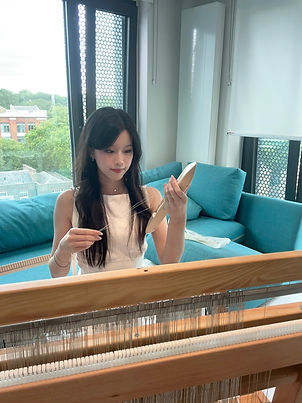
Why weaving?
I am primarily interested in weaving as a way of articulating time. Weaving itself is a process grounded in time as it is time consuming.
Based on the assumption "that one’s investment of one’s time in these processes of labor contributes to the affective emotions to a large extent", when one spends more time on something, one becomes more emotionally connected to it (Mishra Ranpura, 2022). Weaving is undeniably a craft which is labour-intensive.As published by Parsons in 2022, weaving is "not only rich with modalities of processes, materialities, a craftperson’s participation, and transformative product outcomes; but it is also rich in semiotics and metaphors" (Mishra Ranpura, 2022).
According to Koselleck’s Sediments of Time: On Possible Histories, to critically analyze theories, we can utilise metaphors (Reinhart Koselleck, 2018).Coincidentally, as mentioned above, weaving is rich in metaphors. The process of weaving starts with warping. Followed by drafting, unwinding, and finally, finishing. This acts as a metaphor for the idea of causes and consequences in a non-linear temporal framework. Every single step is influenced by past steps. Likewise, every step influences the subsequent step. With its sequential nature, weaving is a perfect tool to use to articulate time.. This very much mirrors the the real world, where while our present actions influence our future, our present moment is also continuously influenced by the past.
As written in Weaving Time by Nishra Ranpura, "weaving itself is laden with spatial and visual symbolism of recurrences. Patterns repeat vertically and horizontally" (Mishra Ranpura, 2022). It is important to note that this repetition or recurrence is controlled by the weaver. Hence, it intrisinctly encapsulates a rhythmic and cyclical sense of time. Every thread weaved and pattern created is an evidence of a moment in time and a testament to the efforts of the weaver. Hence the completed weave becomes evidence to the process that went into its creation.In other words, a temporal record.
We can bring this topic of the relationship between weaving and the articulation of time further by looking at Kubler's The Shape of Time. Kubler writes that the "occurrence of things is also governed by invention, repetition, and discard" (Kubler, 2008). In weaving, this can be seen as each weaving pattern or technique follows a cyclical trend: invention, repetition, and finally discarded / evolved over time. On one hand, just like how present actions influence future conseuqnces, weavers stand on the shoulders of giants in the industry to invent better patterns.Weaving, hence, becomes a great tool to articulate time, where each piece is a culmination of historical techniques and contemporary innovations.
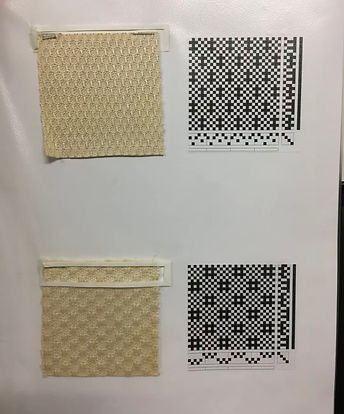
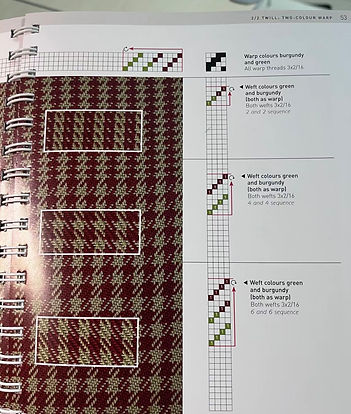
Examples of some weaving patterns: Designing of weaving patterns begin with a weaving draft. Throughout history, weaving patterns have become more advanced and complicated.With advancements in technology such as Photoshop and AI, weaving patterns has reached new levels of sophiscation.
How weaving works:
When I initially embarked on this journey, I expected myself to be able to master the skill within a week. I did not expect weaving to be so technical. Currently, I would say that I am able to complete the most basic of weaves. This is sufficient in my practice as I am weaving together painted silk strips, and not directly using the threads to create patterns. In other words, my focus is still on painting. However, I still have a long journey to go, as I am still not expertly skilled at controlling the loom.
Using the loom starts with setting up the loom.
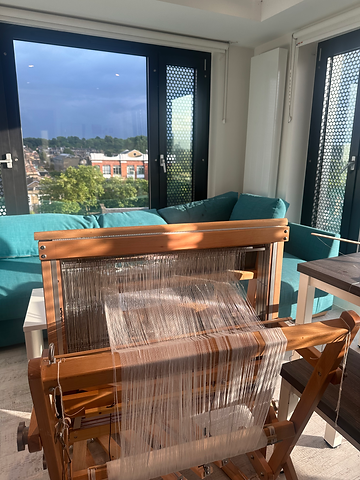
This is the loom I am currently using, and it is how a fully set-up loom looks like
Step 1: Tie the linen thread to the metal bar
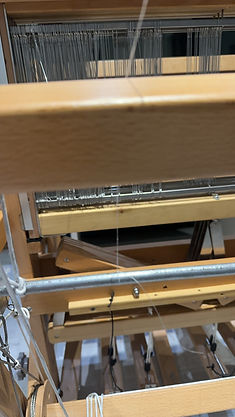
Step 2: Pass the line thread through the comb ( repeat till you get the desired width)
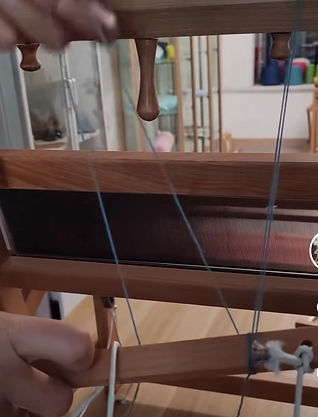
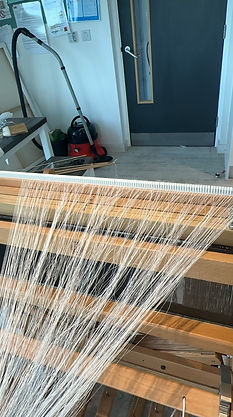
Step 3: Pass the linen threads through the heddles
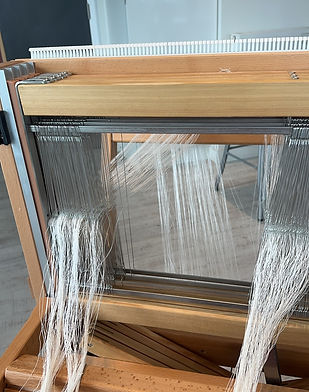
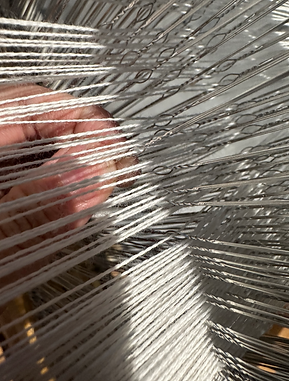
Depending on the design of weave, the linen threads are passed through the reeds in varying ways. As I am using the most basic of weaving techniques, I pass the threads through the heddle in the sequence of :
4=> 3=> 2=>1
Step 3: Pass the linen threads through the metal reeds
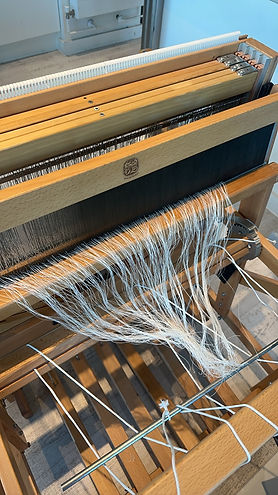
The linen threads a passed through the metal reed in the same sequence as the way they were passed through the heddles:
4=>3=>2=>1
Step 4: Tie the linen threads to the metal bar
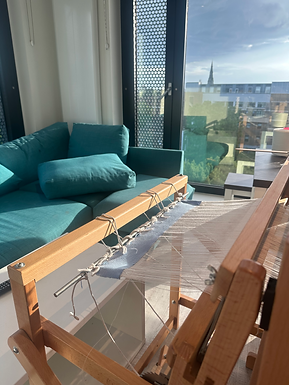
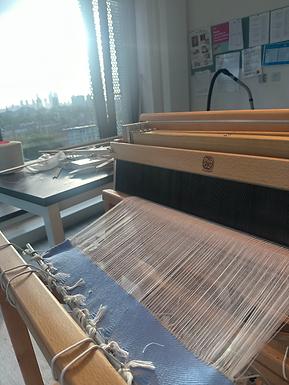
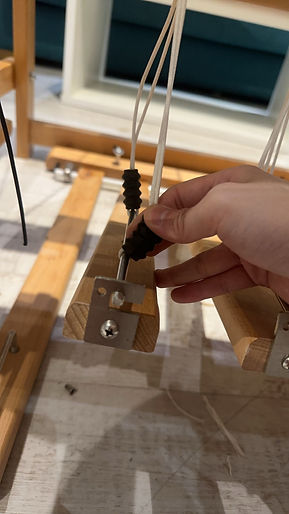
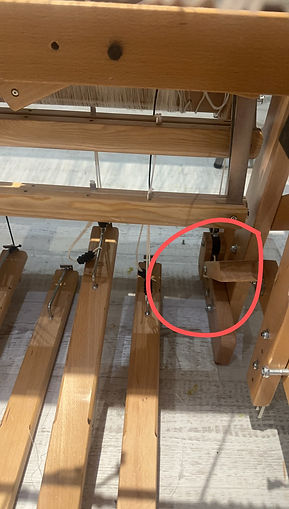
Step 5: Adjust the tension of the linen threads via the foot peddles
Kubler, G. (2008). The Shape of Time. Yale University Press
.Mishra Ranpura (2022). Weaving Time. [online] Nishra Ranpura. Available at: https://nishraranpura.com/weaving-time [Accessed 20 Nov. 2024].
Reinhart Koselleck (2018). Sediments of Time. Stanford University Press.